
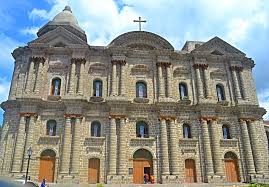
Nestled atop a gentle hill in the historic town of Taal, Batangas, the Minor Basilica of Saint Martin of Tours—more famously known as the Taal Basilica—commands the landscape with a presence that is both awe-inspiring and deeply serene. To call it merely a church feels insufficient. It is a monument to faith that has weathered volcanic fury, a masterpiece of Italian Baroque architecture transplanted onto Philippine soil, and the undeniable spiritual and cultural heart of a community. For centuries, its towering façade and cavernous interior have borne silent witness to the town’s tumultuous history, from the boom of the coffee trade to the fervor of revolution. Today, recognized as the largest Catholic church building in the Philippines and in all of Asia, the Taal Basilica is not just a destination for the devout but a living, breathing piece of history that continues to shape the identity of Taal and inspire all who walk through its massive doors.
Walking into the Taal Basilica for the first time is an experience that transcends sight; it is a full-bodied encounter with scale and devotion. Sunlight filters through high windows, illuminating a forest of Doric and Ionic columns and trompe l’oeil ceilings that stretch toward the heavens. The air feels different—cool, still, and heavy with centuries of whispered prayers. You are standing in a space 88.6 meters long and 48 meters wide, dimensions that officially crown it as a giant among churches. But its significance is measured in more than just meters. The Taal Basilica represents the extraordinary ambition of a small-town community, the resilience of a people repeatedly tested by nature’s wrath, and the enduring legacy of Spanish colonial influence, filtered through a uniquely Filipino spirit. This article is a journey through time and stone, exploring the epic history, breathtaking architecture, and vibrant living culture that converge at this iconic site, the magnificent Taal Basilica.
A Phoenix Rising from Ash and Stone: The Epic History of the Basilica
The story of the Taal Basilica is not one of a single construction but a saga of relentless rebirth, a testament to a faith that refused to be buried by ash or shattered by quake. Its origins date back to 1575, just three years after Augustinian missionaries founded the town of Taal near the restive shores of Taal Lake. The first church, built from light materials under the guidance of Fr. Diego Espinar, was a humble beginning dedicated to Saint Martin of Tours. As the community grew, so did its house of worship. A stronger, more permanent structure replaced the original in 1642, symbolizing the town’s rising prominence. However, the church’s original location placed it directly in the shadow of one of the world’s most active volcanoes—a relationship that would define its destiny.
The turning point came in 1754 with the largest recorded eruption of Taal Volcano. The catastrophe was absolute. The thriving town of Old Taal, along with its church, was utterly consumed and buried. From this devastation emerged a pivotal decision: to relocate the entire town away from the volatile lakeshore to a safer, elevated site overlooking Balayan Bay. The ruins of that doomed church can still be seen today in the present-day municipality of San Nicolas, a silent sentinel to the past. In 1755, on the new town site, the arduous task of rebuilding began anew under Fr. Martín Aguirre. This second church, improved over decades by successive priests, stood as a beacon of recovery for nearly a century.
Table: The Timeline of Destruction and Rebuilding of the Taal Basilica
| Year | Event | Outcome |
|---|---|---|
| 1575 | First church built in Old Taal (near Taal Lake) | Structure of light materials. |
| 1754 | Cataclysmic eruption of Taal Volcano | Original town and church completely destroyed. |
| 1755 | Town relocates; new church construction begins | Foundation laid at present site overlooking Balayan Bay. |
| 1852 | Major earthquake strikes the region | The 18th-century church is severely damaged. |
| 1856 | Construction begins on the present-day basilica | Commissioned by Fr. Marcos Antón, designed by Luciano Oliver. |
| 1878 | Construction completed | Final touches, including the grand altar, are added by Fr. Agapito Aparicio. |
Disaster struck again in 1852 when a powerful earthquake, likely related to the volatile volcanic region, left the church in ruins once more. Undeterred, the community embarked on its most ambitious project yet. In 1856, under the leadership of Fr. Marcos Antón, construction began on the monumental structure we see today. The Spanish architect Luciano Oliver was commissioned to design a church of unprecedented scale and grandeur. The work was a massive communal effort. Adobe stones were quarried locally and carried uphill by hand; sand was transported from the seashore in the aprons and handkerchiefs of women and children. Though inaugurated in an unfinished state in 1865, the building was finally completed in 1878 under Fr. Agapito Aparicio, who added the magnificent 24-meter-high Doric altar. This church, born from perseverance, was finally ready to claim its title.
The 20th and 21st centuries brought formal recognition and new challenges. It was declared a Minor Basilica in 1954, a prestigious title from the Vatican. In 1974, the Philippine government recognized its immense historical value, declaring it a National Historical Landmark. Yet, the basilica’s trial by fire and earth was not over. It sustained damage from earthquakes in 2017 and, most recently, was covered in a thick layer of ash during the Taal Volcano eruption of January 2020. Each time, restoration efforts have risen to meet the need, with the National Historical Commission of the Philippines turning over a meticulously restored basilica to the Archdiocese of Lipa in November 2020. This cycle of destruction and renewal is woven into the very fabric of the Taal Basilica, a true phoenix in stone.
Architectural Anatomy of a Colossal Basilica
To stand before the Taal Basilica is to understand the meaning of architectural grandeur. Designed in the Italian Baroque style with a classic cruciform (Latin cross) layout, its scale is deliberately awe-inspiring, meant to elevate the spirit and reflect the glory of God. The façade is a symphony of geometric precision and classical influence, often compared to a scaled-down version of St. Peter’s Basilica in Rome. Its most striking feature is the regimented elegance of 24 colossal columns, arranged in two tiers of six pairs each, employing both the sturdy Doric and the scroll-topped Ionic orders. This imposing front, rising 28 meters high, is crowned by a triangular pediment and flanked by a stately, if understated, bell tower.
Stepping across the threshold is when the true magnitude reveals itself. The interior is a vast, luminous space that masterfully uses perspective and artistry to create a sense of infinite reach. The nave stretches an incredible 88.6 meters, with a width of 15.5 meters, allowing for multiple aisles of pews where a typical church might have only two. The eye is immediately drawn upward to the breathtaking trompe l’oeil ceilings. This “trick of the eye” painting technique, executed in creamy whites and soft peaches, creates stunning three-dimensional illusions of ornate relief work, coffered ceilings, and divine scenes that seem to arch into a celestial dome. At the heart of the basilica, beneath the central cupola that soars 44.5 meters high, the grand transept intersects the nave, creating a majestic space flooded with light.
The focal point of this immense sanctuary is the monumental main altar, a masterpiece added by Fr. Agapito Aparicio upon the church’s completion in 1878. Soaring 24 meters high and 10 meters wide, it is a towering tableau of classical design crafted from rich, dark wood. Framed by stately Doric columns and populated with statues of saints and angels, the altar commands reverence. Within it rests a unique treasure: a silver tabernacle, reputed to be the only one of its kind in the Philippines. The architectural journey continues to the baptistery, notable for its floor tiled with elegant, imported European ceramics, a detail that speaks to the global connections and refined tastes of its builders. Every element, from the grand scale to the minute detail, was conceived to inspire wonder.
“The Taal Basilica is a testament of faith that this small town built so impressive a church. It should be better known and studied.” – Ambeth Ocampo, Historian
This architectural marvel did not rise from the drawing board of a single genius but from the collective muscle and devotion of an entire community. The massive adobe stones were painstakingly quarried from nearby hills and transported to the site. In an era before modern machinery, the structure was held together not by cement, but by traditional lime mortar, a testament to the builders’ skill that has allowed the basilica to withstand the tests of time and tremor for over 140 years. The Taal Basilica is more than an Italian Baroque design; it is a Filipino achievement, a physical manifestation of communal faith, determination, and artistry that has rightfully earned its place as an architectural icon of the nation and the continent.
The Spiritual Heartbeat of Taal Town
The Taal Basilica is far more than a static monument or a tourist attraction; it is the vibrant, living heart of Taal. Its rhythms are the rhythms of the town itself, dictating the calendar of daily life and annual celebration. As the Parish of Saint Martin of Tours, it serves as the spiritual home for generations of Taaleños, for whom baptisms, weddings, and Sunday masses within its hallowed walls are cherished family milestones. The basilica’s presence is a constant, its silhouette visible from points throughout the town and even in neighboring Lemery, a perpetual reminder of faith and identity on the horizon.
The annual cycle reaches its zenith every November 11th, the Feast Day of Saint Martin of Tours, the town’s patron saint. This is not a quiet observance but a vibrant, colorful fiesta that transforms the entire town. The basilica becomes the epicenter of religious and cultural fervor. Grand processions wind through the decorated streets, with the image of the saint carried aloft by devoted townspeople. The air fills with music, prayer, and the aroma of festive food. Homes are opened to guests, embodying the Filipino spirit of hospitality. This celebration is a powerful reaffirmation of community, a shared heritage that connects the present to the past, all centered on the Taal Basilica.
Beyond the feast day, the basilica is a key pillar in a network of profound local devotions. It shares a deep spiritual connection with the nearby Arch and Shrine of Our Lady of Caysasay, located a short walk away down the historic San Lorenzo Ruiz Steps. The revered 17th-century image of the Virgin is enshrined there, and its history is intertwined with the parish. In fact, the Taal Basilica was restored in 1953 specifically in preparation for the canonical coronation of Our Lady of Caysasay. Pilgrims often visit both sites, moving from the grandeur of the basilica to the intimate, miraculous atmosphere of the Caysasay shrine and its legendary Sta. Lucia Wells, whose waters are believed to possess healing properties.
This role as a spiritual anchor has also made the basilica a witness to history beyond the religious. During the late 19th century, when Taal was a prosperous center fueled by the coffee boom and a hotbed of revolutionary sentiment, its influential families—many of whom were devout parishioners—played crucial roles in the fight for Philippine independence. The church, standing imposingly in the plaza, watched as the town’s ilustrados navigated their dual identities as Spanish colonial subjects and budding Filipino nationalists. Today, it continues to be a place of gathering and solace, a sanctuary that has comforted its people through volcanic eruptions, earthquakes, and all of life’s personal trials. The Taal Basilica does not just house faith; it actively nurtures and protects the soul of a community.
A Living Museum at the Basilica’s Feet: Exploring Taal’s Heritage
To visit the Taal Basilica and not explore the surrounding Taal Heritage Town is to hear only one note of a magnificent symphony. The basilica is the crown jewel, but it is set in a diadem of beautifully preserved history. Stepping out onto the Taal Park (Plaza) in front of the church is like stepping into a living museum of Spanish colonial and Filipino ilustrado life. The town’s layout is classic Spanish colonial: the majestic church, the municipal hall, the market, and grand ancestral homes all radiating from the central plaza. A leisurely walk through the quiet, narrow streets, where the pace of life feels mercifully detached from the modern world, reveals one heritage treasure after another.
These treasures are the famed ancestral houses or bahay na bato (stone houses). Unlike museums with velvet ropes, many of these are still private homes, painstakingly maintained or adaptively restored, allowing history to breathe. A prime example is the Marcela and Felipe Agoncillo Museum, the home of the remarkable woman who sewed the first official Philippine flag. Nearby, the adjacent Villavicencio houses tell a story of love and revolution. The “Wedding Gift House” was a lavish present from Don Eulalio Villavicencio to his wife, Doña Gliceria, who would later be known as the “Godmother of the Revolutionary Forces” for her steadfast financial and material support to the Katipunan. These homes are not just architectural beauties with capiz shell windows and grand staircases; they are shrines to patriotism.
Table: Key Heritage Sites in Taal Town
| Site Name | Type | Historical & Cultural Significance |
|---|---|---|
| Taal Basilica | Church | Largest Catholic church in Asia; National Historical Landmark. |
| Marcela Agoncillo House | Ancestral House/Museum | Home of the seamstress of the first Philippine flag. |
| Villavicencio Wedding Gift House | Ancestral House | Gift from a revolutionary financier to his wife; showcase of 19th-century opulence. |
| Galleria Taal | Museum | Housed in an ancestral home; features the country’s premier collection of vintage cameras. |
| Shrine of Our Lady of Caysasay | Church & Pilgrimage Site | 17th-century shrine housing a miraculous image; site of the Sta. Lucia Wells. |
| Sta. Lucia Wells & Arch | Religious Site | Twin wells under a coral arch; believed to have healing waters from a Marian apparition site. |
For a fascinating change of pace, the Galleria Taal is a must-visit. Housed in the impeccably restored Ilagan-Barrion ancestral house, it is the Philippines’ first and only museum dedicated to vintage cameras. The collection, amassed by enthusiast Manny Inumerable, is breathtaking in its scope, featuring rare pieces from the dawn of photography, including a demonstration Daguerreotype camera. It’s a poignant reminder of how people have always sought to capture and preserve moments of beauty and truth—a mission the entire town of Taal embodies. After a day of exploration, visitors can immerse themselves fully by staying in a restored heritage house like Villa Tortuga or Casa Punzalan, where one can sleep under the same massive wooden beams that sheltered generations past.
The experience is rounded out by engaging with Taal’s living crafts. The town is renowned as the Balisong (butterfly knife) and Barong Tagalog capital of the Philippines. Artisans in small shops still practice the meticulous craft of forging the famous blades, while weavers and embroiderers create the delicate piña and jusi fabrics for the national dress. To explore the Taal Basilica and its surrounding town is to engage in a holistic cultural journey. It is a dialogue between the monumental and the intimate, the sacred and the domestic, the historical and the artisanal—all converging to tell the rich, layered story of Filipino identity.
FAQs About the Taal Basilica
What is the Taal Basilica and why is it famous?
The Taal Basilica, formally known as the Minor Basilica and Parish of Saint Martin of Tours, is a Roman Catholic church in Taal, Batangas. It is most famous for being recognized as the largest Catholic church building in the Philippines and in all of Asia, with awe-inspiring dimensions of 88.6 meters in length and 48 meters in width. Beyond its size, it is renowned for its stunning Italian Baroque architecture, its tumultuous history of surviving volcanic eruptions and earthquakes, and its status as a National Historical Landmark and the spiritual center of a rich heritage town.
How do I get to the Taal Basilica from Manila?
Traveling to the Taal Basilica from Manila is a straightforward journey by road. The most common way is to take a bus bound for Lemery, Batangas. Buses like JAM and DLTBCo depart from terminals near the LRT Gil Puyat (Buendia) station in Pasay. Inform the conductor that you are going to the Taal Basilica. Some buses pass directly by the church on the national road. If your bus takes the bypass road, you can alight at the Taal-Lemery junction and take a short jeepney or tricycle ride to the basilica, which sits prominently on a hill in the town proper.
What are the must-see features inside the Taal Basilica?
Upon entering the Taal Basilica, the sheer scale of the nave will immediately strike you. Be sure to look up to admire the magnificent trompe l’oeil paintings on the ceilings and dome, which create incredible 3D effects. Walk towards the front to see the gigantic main altar, which stands 24 meters high and features a unique silver tabernacle. Take time to appreciate the play of light through the windows on the rows of classical columns and explore the side altars in the transept. If accessible, a climb to the bell tower offers a panoramic view of the heritage town and Balayan Bay.
What other historical sites are near the Taal Basilica?
The Taal Basilica is the centerpiece of the larger Taal Heritage Town, which is packed with significant sites within walking distance. Directly in front is the town plaza. A short stroll down Calle Marcella Agoncillo leads to the Marcela Agoncillo House and the Villavicencio ancestral houses. Don’t miss the Galleria Taal camera museum. For a spiritual pilgrimage, walk or take a trike to the San Lorenzo Ruiz Steps, which descend to the Shrine of Our Lady of Caysasay and the Miraculous Sta. Lucia Wells. The town is also famous for shops selling handmade balisong knives and barong Tagalog.
When is the best time to visit Taal Basilica and the town?
The Taal Basilica is open year-round, but the most culturally vibrant time to visit is during the feast day of Saint Martin of Tours on November 11. The town comes alive with a grand fiesta, processions, and celebrations. For a quieter experience with pleasant weather, the cooler dry season from November to April is ideal. Weekdays are generally less crowded than weekends. If you wish to see the interior in its best light, visit in the morning when sunlight streams through the windows, beautifully illuminating the altar and ceilings. Always check for local announcements, as the basilica may occasionally close for special events or in the rare event of heightened volcanic activity in the region.
Conclusion
The Taal Basilica stands as an undeniable testament to the power of collective faith and resilience. Its story, written in volcanic ash and reconstructed with coral stone, is a powerful metaphor for the Filipino spirit—one that faces catastrophe not with surrender, but with renewed determination to build something even more beautiful and enduring. More than just a record-breaking architectural feat, it is the living, beating heart of a community, a guardian of history, and a wellspring of identity for the people of Taal.
A visit to the Taal Basilica is more than a checkbox on a tourist itinerary; it is a pilgrimage into the soul of the Philippines. It is an invitation to marvel at human artistry, to reflect on the passage of centuries, and to feel the quiet, steady pulse of devotion that has sustained this place through unimaginable trials. From its colossal altar to the intimate ancestral houses at its feet, the heritage town offers a complete and immersive journey. In preserving the Taal Basilica and its surroundings, the Philippines safeguards a crucial chapter of its national narrative, ensuring that future generations can continue to walk these hallowed aisles, look up in wonder, and connect with the profound legacy of faith, history, and community that this magnificent basilica represents.