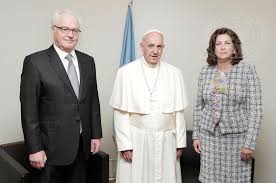
The direct question of “Pope Francis wife” emerges from a fundamental misunderstanding of Catholic clerical life, yet opens a meaningful exploration of what spiritual marriage and universal fatherhood signify in the context of the modern papacy. Pope Francis, born Jorge Mario Bergoglio, dedicated his entire adult life to the Catholic Church through the Society of Jesus (Jesuits), an order requiring vows of poverty, chastity, and obedience. For a priest, bishop, and especially a pope, there is no earthly wife in the traditional sense; the concept is spiritually and doctrinally incompatible with the vocation. The commitment is to a different kind of relationship—one with the Church itself, often described in Catholic theology as a spousal bond between Christ (represented by the clergy) and his Church. This foundational celibacy, a discipline maintained in the Latin Rite of Catholicism for priests, is integral to the pope’s identity and mission. It frees him for a universal paternity, making him a spiritual father to over a billion Catholics worldwide. His life’s journey from a young man recovering from illness in Buenos Aires to the Bishop of Rome was a path chosen instead of marriage, a conscious offering of his entire self for his faith. Therefore, inquiries about a papal spouse lead us not to a person, but to a profound theological concept and a historical tradition that has shaped the Church for nearly a millennium.
The intrigue behind the question, however, is understandable in a world where leadership and personal life are often intertwined. People naturally wonder about the human relationships of influential figures. In Francis’s case, his profound empathy, pastoral warmth, and frequent teachings on love, marriage, and family might subconsciously prompt some to imagine an analogous personal partnership in his own life. Yet, his authority and teachings on these matters stem not from the experience of a domestic family, but from a lifetime of pastoral care, theological study, and a deep, prayerful reflection on the human condition. His “family” is the global Church, and his “spouse,” in mystical terms, is the Church community he serves. This piece will explore the historical roots of clerical celibacy, the unique nature of the pope’s symbolic marriage to the Church, and how Francis, through his emphasis on mercy and inclusivity, has expanded the understanding of love and belonging within this vast spiritual family.Pope Francis Wife
The Historical Foundations of Clerical Celibacy
The discipline of clerical celibacy in the Catholic Church is not a doctrine revealed in Scripture but an evolving tradition of discipline, one with deep historical and spiritual roots. To understand the impossibility of a “Pope Francis wife,” one must trace the development of this practice. In the early centuries of Christianity, many apostles and clergy, including the Apostle Peter, were married. The emphasis was on apostolic succession and leadership, not the marital status of the clergy. However, a growing ascetic ideal, championed by Church Fathers like St. Augustine, began to promote the superiority of the celibate life as a way to imitate Christ and serve God with an “undivided heart”. This ideal held that refraining from marriage allowed for greater spiritual focus and availability for ministry.
A major turning point came in the Middle Ages. For centuries, priests, especially in rural areas, often lived in marriage-like relationships or had concubines. This practice led to significant problems, including the inheritance of Church property by priests’ children, which threatened the economic stability and independence of the Church. To combat this, a series of reform popes, most notably Pope Gregory VII in the 11th century, vigorously enforced celibacy laws. The Second Lateran Council in 1139 definitively declared clerical marriages not only invalid but also sacrilegious. This reform was as much about consolidating ecclesiastical authority and protecting Church assets as it was about spirituality. It formally severed the clergy from the secular obligations of family, theoretically ensuring their loyalty was solely to the Church. This historical context shows that the celibate priesthood, as experienced by Pope Francis, is the product of a long, complex evolution intertwining spiritual ideals with practical Church governance.
It is crucial to distinguish between the Latin Rite, which mandates celibacy for priests (with rare exceptions for married converts from other traditions), and the Eastern Catholic Churches in communion with Rome. Many Eastern Catholic Churches, following their own ancient disciplines, have always ordained married men to the priesthood (though not to the episcopacy). This diversity within Catholicism itself highlights that celibacy is a discipline, not an unchangeable dogma.Pope Francis Wife However, for the papacy, rooted in the Latin tradition, the expectation of celibacy has been absolute for nearly a thousand years. The last pope believed to have been married was Adrian II in the 9th century, and even then, it was a source of scandal. Thus, the historical path to the modern papacy is one where the role of a “wife” was systematically and intentionally removed from the clerical structure, creating the model of a spiritually espoused pontiff we know today.
The Pope’s Mystical Marriage: The Church as Spouse
If a pope has no earthly wife, to what or to whom is he wed? Catholic theology provides a rich, symbolic answer: the Church itself. This concept, known as Sponsa Christi (the Bride of Christ), is pivotal. The pope, as the Bishop of Rome and successor of Peter, is seen as the vicar (representative) of Christ on Earth. In this symbolic framework, he stands in a spousal relationship with the Church, which is collectively referred to as the Bride of Christ. Pope Francis Wife This is not a romantic or physical union but a profound mystical and covenantal bond. It signifies the pope’s total commitment, love, and responsibility for the well-being, guidance, and salvation of the entire Catholic community. His “fatherhood” flows from this spousal identity; he is a father because he is first a spouse to the mother Church.
This spiritual marriage manifests in the pope’s liturgical role, titles, and duties. He is the “Servant of the Servants of God” and the “Supreme Pontiff,” titles that denote a role of spousal service and bridge-building (pontifex means “bridge-builder”). In ceremonies, he wears a ring, the Fisherman’s Ring, a symbol of his authority and his marriage to the Church. When a pope dies, this ring is ceremonially destroyed, signifying the end of that particular bond of office. His daily work—governing, teaching, sanctifying—is an act of care for his spouse. Every encyclical he writes, every diocese he visits, every sacrament he confers is an act within this sacred relationship. This understanding transforms the question from “Who is Pope Francis wife?” to “How does Pope Francis love and serve his spouse, the Church?”
Pope Francis has uniquely expressed this spousal relationship through a lens of mercy, healing, and inclusivity. His papacy has been marked by a desire to embrace those on the peripheries, to heal wounds, and to make the Church a “field hospital” for a wounded world. This can be seen as a spousal act of nurturing and protection. His convening of the Synod on Synodality, a multi-year process of listening and discernment involving laypeople worldwide, is a powerful example of seeking communion with his spouse. By emphasizing a Church that is more synodal (journeying together), he is reinforcing that his spousal leadership is not one of domination, but of accompaniment, dialogue, and shared mission within this mystical marriage.
https://headlinenest.com/wingless-pet-peeve/
Redefining Family and Love in a Global Church
Without a biological nuclear family, Pope Francis has consistently redefined and emphasized the concept of family on a global and spiritual scale. His teachings and actions present the Church itself as a family and highlight the sanctity of domestic families. His landmark apostolic exhortation, Amoris Laetitia (The Joy of Love), is a profound reflection on the beauty and challenges of family life. While he cannot draw from personal experience as a husband or father, he draws from a lifetime of pastoral proximity to families in the slums of Buenos Aires, in parishes, and in confessionals. His teachings are therefore deeply empathetic, focused on the reality of family struggles, the need for compassion, and the importance of unconditional love.Pope Francis Wife
Francis’s own “family” is the global communion of Catholics. He refers to the faithful as “brothers and sisters” and embodies a grandfatherly, approachable papacy. He broke tradition by living in the Domus Sanctae Marthae guesthouse instead of the papal apartments, choosing to live in community where he shares meals with staff and guests. This simple act reshapes the papal “household” from an imperial court to a more familial setting. Furthermore, his focus on social justice—critiquing “trickle-down” economics, defending migrants and refugees, and advocating for action on climate change—is an expression of paternal and spousal care for the entire human family, especially the poorest and most vulnerable members of his Church.
His approach to controversial issues also reflects this familial mindset. While upholding the Church’s doctrinal position on marriage as between a man and a woman, he has famously said, “If a person is gay and seeks God and has good will, who am I to judge?” He has allowed for the pastoral blessing of individuals in same-sex relationships (while clarifying the Church does not bless same-sex unions sacramentally), emphasizing that all are children of God and belong in the family of the Church. This inclusive, merciful stance has been a hallmark of his papacy, extending the boundaries of the spiritual family and focusing on accompaniment rather than exclusion. In this way, the question of a “Pope Francis wife” finds its truest answer in his expansive, active, and merciful love for the human family, a love that seeks to include rather than divide.
Vows of Chastity and the Jesuit Charism
To fully comprehend Pope Francis’s life path, one must understand the specific spiritual engine that drove it: the Society of Jesus, or the Jesuits. Jorge Mario Bergoglio didn’t just become a priest; he entered a religious order known for its intellectual rigor, missionary zeal, and radical commitment to the Church’s mission. The Jesuit vow of chastity, taken alongside poverty and obedience, is not seen as a mere restriction but as a freedom for apostolic availability. Jesuits are often called “contemplatives in action,” and their celibacy is integral to being sent anywhere in the world, at a moment’s notice, to serve where the need is greatest. For the young Bergoglio, recovering from a severe illness, this call represented a total gift of self.Pope Francis Wife
His formation as a Jesuit was demanding. After joining the novitiate in 1958, he studied humanities, philosophy, and theology, taught literature and psychology, and served as a master of novices. This period honed the deeply Ignatian spirituality that marks his papacy: a spirituality of finding God in all things, of discernment, and of a personal love for Jesus Christ. The Jesuit ideal is to be a “man for others,” and celibacy is a practical and spiritual commitment to that end. It removes the legitimate and beautiful obligations of a wife and children to create space for universal kinship. When asked about his personal life, Francis often reflects this Ignatian perspective, speaking of his vocation as a loving call to which he responded with joy.
This background is essential for understanding his leadership style. His simplicity (refusing ornate vestments, keeping his simple iron pectoral cross), his focus on the poor, and his pragmatic, pastoral approach to governance are all deeply Jesuit. His decision-making, such as his historic apology for the Church’s role in the Canadian residential school system or his diplomatic efforts to restore U.S.-Cuba relations, can be seen through the lens of Jesuit discernment and commitment to justice. The Jesuit charism provides the inner architecture for his papacy, making the notion of an earthly “wife” not just irrelevant but antithetical to the very structure of his consecrated life. His spousal relationship is with his mission, which is the mission of the Church.
The Symbolic and Practical Role of Women in the Papal Ministry
While the pope has no wife, the role of women in supporting, influencing, and shaping the ministry of the papacy is significant and evolving. Historically, women like St. Catherine of Siena in the 14th century exerted tremendous moral influence on popes, urging them to return to Rome from Avignon. In the modern era, Pope Francis has made historic steps to include women more formally in Church governance. He has appointed women to several high-ranking positions in the Roman Curia (the Church’s central administration), making them full members of dicasteries (departments) with voting rights, which was previously reserved for cardinals and bishops. For example, he appointed Sister Nathalie Becquart as an undersecretary of the Synod of Bishops, giving her a vote in the Synod assembly—a first for a woman.Pope Francis Wife
Francis frequently speaks of the need for a more “incisive” presence of women in the Church and criticizes clericalism, a mindset that excludes the laity, particularly women, from meaningful participation. He has established commissions to study the history of women deacons in the early Church, though he has ruled out opening the priesthood to women. His theological vision emphasizes that women bring essential qualities of receptivity, tenderness, and nurturing to the Church’s life, which are not inferior to hierarchical roles but are complementary and vital. He often references the Virgin Mary not only as a model of faith but as the “first disciple” and the heart of the Church.
Practically, his daily life is supported by a community that includes women religious (nuns) who serve at the Domus Sanctae Marthae and female lay experts who work in various Vatican offices. His own spiritual life has undoubtedly been shaped by women throughout his journey—from his mother, Regina María Sívori, to religious sisters he worked with in Argentina. Thus, while there is no “First Lady” of the Vatican in a spousal sense, the feminine genius,Pope Francis Wife as Francis calls it, plays a crucial and growing part in his papacy. This represents a shift from a model where a pope might have relied solely on a private, spousal confidante to a more institutional and collegial integration of women’s perspectives into the heart of Church leadership.
A Legacy of Spiritual Paternity
Pope Francis’s death on April 21, 2025, marked the end of a transformative papacy that redefined the world’s understanding of spiritual leadership. His legacy is one of a father who embraced the world with open arms, who prioritized the margins over the center, and who consistently preached a gospel of mercy and encounter. The question of a “Pope Francis wife” fades into insignificance against the backdrop of this monumental, fatherly love manifested in action. He leaves behind a Church that, while often divided over his reforms, has been irrevocably nudged toward a more pastoral, compassionate, and synodal identity.
His successor, Pope Leo XIV, inherited this legacy. The very fact that Francis’s papacy has sparked such global conversation—about inclusion, economic justice, and ecological care—proves that his influence transcended the confines of traditional religious authority. He became a moral voice for the world. His life answered the question of relationship not with a name, but with a witness: a witness to a love that chooses universal spiritual paternity over biological fatherhood, that chooses service to the poor over palace comforts, and that chooses dialogue with a complex world over fortress-like isolation. In the final analysis, Pope Francis was married to his mission, and his children are all those, Catholic or not, who heard in his words a call to greater kindness, justice, and care for our common home.
Table: The Evolution of Key Concepts Related to Papal Relationships
| Concept | Historical Context | Expression in Pope Francis’s Papacy |
|---|---|---|
| Papal Celibacy | Evolved from early-married clergy to mandatory discipline after 1139 AD to protect Church property & affirm spiritual focus. | Lived as a Jesuit vow; foundation of his availability for global ministry and universal fatherhood. |
| Church as Spouse | Theological concept (Sponsa Christi) developed over centuries, casting the pope as vicar of Christ in spousal union with the Church. | Expressed through synodality, a “field hospital” model of mercy, and pastoral care for all members of the Church. |
| Spiritual Family | Popes traditionally viewed as “Holy Father” to the faithful. | Expanded to emphatic inclusion of marginalized, focus on human family & ecology, and “brothers and sisters” language. |
| Role of Women | Historically limited to informal influence (e.g., mystics, benefactors). | Formal inclusion in Vatican roles with voting rights; emphasis on “incisive” presence and feminine genius in Church life. |
A Reflection from History: The evolution of personal relationships in leadership contexts is not unique to the papacy. As historian Nichi Hodgson notes in The Curious History of Dating, societal structures around marriage and partnership have constantly shifted, from economic arrangements to love matches. The papacy’s adherence to celibacy is one such unique structural choice, preserving a specific form of spiritual focus amidst a world where the norms of relationship continue to change.
Frequently Asked Questions
Did Pope Francis Wife ever have a girlfriend or consider marriage before becoming a priest?
As a young man, Jorge Mario Bergoglio experienced the normal development of human affection. He has openly acknowledged that during his seminary years, he had a crush on a young woman, which caused him a period of serious doubt about his religious vocation. This moment of discernment is not uncommon for those entering religious life. Ultimately, he felt a stronger call to the priesthood and the Jesuit order, making a perpetual vow of chastity in 1960. This vow, which excludes marriage and exclusive romantic relationships, became the definitive direction of his life.
How can Pope Francis teach authoritatively about marriage and family if he has never been married?
The Catholic Church’s teaching on marriage is not based on the personal experience of its ministers but on sacred Scripture, tradition, and natural law theology developed over two millennia. Priests and popes are trained as moral and pastoral theologians. Furthermore, Pope Francis’s authority comes from his office as successor of Peter, not from his personal biography. His pastoral approach is informed by a lifetime of listening to families in confession and ministry, especially in the diverse and often challenging contexts of urban Argentina. His exhortation Amoris Laetitia was itself the result of a global consultation with bishops and laypeople.Pope Francis Wife
Who manages the Pope’s household and daily affairs if there is no papal spouse?
The papal household is managed by a dedicated staff and administrative structure. Since Pope Francis Wife chose not to live in the traditional papal apartments, his daily life at the Domus Sanctae Marthae is supported by community staff. The Prefecture of the Papal Household, headed by a cardinal, oversees scheduling, ceremonies, and guests. His personal needs are attended to by consecrated religious sisters and a small group of papal aides. This functional support system replaces the role a spousal partner might play in a domestic setting, allowing the pope to focus on his spiritual and global responsibilities.
Has there ever been a married pope in Catholic history?
Yes, but in the very early centuries of the Church. Several popes in the first millennium are believed to have been married before their ordination or even during their early clerical life. The most commonly cited example is St. Peter himself, the first pope, who was married (the Gospels mention his mother-in-law). However, as the discipline of clerical celibacy became strictly enforced from the 11th century onward, a married pope became unthinkable. The last pope known to have been married was Pope Adrian II (867–872), and his wife and daughter lived with him in the Lateran Palace, which caused considerable controversy.
Does the concept of a celibate pope make him disconnected from the lives of ordinary people?
Pope Francis has argued the opposite. He believes that celibacy, when lived authentically as a gift for others, can create a greater capacity for universal kinship and empathy. It is meant to free him to love and serve all people as a spiritual father without exclusive ties. His lifestyle choices—eschewing luxuries, visiting prisons and refugee camps, washing the feet of inmates—are deliberate efforts to stay connected. His focus on social justice issues like poverty, migration, and inequality demonstrates a deep engagement with the struggles of ordinary people. His connection is pastoral and paternal, rather than spousal and domestic.Pope Francis Wife
Conclusion
The journey to answer “Pope Francis wife” leads us through the corridors of history, into the depths of Catholic theology, and finally to the heart of a man who defined his life by a different kind of love. There is no Mrs. Pope Francis, and there cannot be, due to the centuries-old spiritual discipline of priestly celibacy in the Latin Church—a discipline Pope Francis embraced wholeheartedly as a Jesuit. Instead of an earthly spouse, he entered into a mystical spousal bond with the Church itself, a commitment that defined his papacy as one of service, mercy, and universal fatherhood. His “family” became the global Catholic community and, indeed, all people to whom he extended his message of care for the poor and for our common home.
His legacy demonstrates that leadership and profound human connection are not contingent on marital status. Through his teachings on family, his inclusive outreach, and his simple, compassionate demeanor, Pope Francis modeled a paternity that was both spiritually potent and deeply human. He redefined the concept of relationship for the highest office in the Catholic Church, showing that the most powerful love can be one that is poured out universally, without exclusion. The question about his wife, while factually simple to dismiss, ultimately opens a window into the beautiful and complex reality of a vocation that chooses to love the world as a spouse and a father, asking nothing in return but the joy of service.Pope Francis Wife