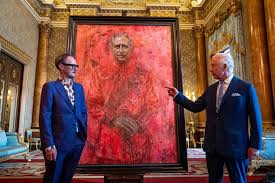
When Jonathan Yeo’s king charles portrait III was unveiled in May 2024, it instantly became one of the most discussed artworks of the decade. The painting, awash in a dramatic red palette, presents the monarch in the uniform of the Welsh Guards, a butterfly resting on his shoulder, against a vivid crimson backdrop. The reaction was immediate and polarized. To some, it was a bold, modern masterpiece that captured the essence of a 21st-century sovereign; to others, its intense color evoked disquieting imagery of blood and fire. This portrait does far more than simply record a likeness—it serves as a complex visual statement about monarchy, identity, and transformation in the modern age. It joins a centuries-old tradition of royal portraiture while deliberately breaking from its conventions, offering a unique window into the character of a man who waited over seven decades to assume the throne.
The creation of a royal portrait is never just an artistic endeavor; it is a political act, a cultural event, and a historical document. For centuries, portraits have been primary tools for monarchs to project power, virtue, and legitimacy. From Hans Holbein’s imposing Henry VIII to the serene coronation portraits of Queen Elizabeth II, these images are crafted narratives. Yeo’s portrait of King Charles enters this storied lineage with a self-aware contemporary twist. It acknowledges the weight of tradition—the military uniform, the symbolic sword—while using a striking, unified color scheme and personal symbolism to create something distinctly of our time. This article will explore this remarkable portrait in full, examining its symbolism, its creation, the artist behind it, and its place within the broader context of King Charles’s life in art. We will see how one painting can encapsulate a lifetime of duty, a passion for the environment, and the profound personal metamorphosis of a prince becoming a king.
The Weight of the Crown: A Historical Context for Royal Portraiture
The tradition of royal portraiture in Britain is a tapestry woven with threads of power, propaganda, and personality. For monarchs, a portrait was never a mere vanity project; it was a vital instrument of state. In an era before photography and mass media, these images were the primary means by which most subjects would ever “see” their sovereign. They were reproduced and distributed to embassies, government buildings, and the homes of loyal nobles, serving as constant visual reminders of royal authority and the stability of the realm. The earliest state portrait in the Royal Collection, a painting of James VI and I from around 1620, establishes this tradition of grandeur, depicting the king in full coronation robes to emphasize his divine right and majestic power. This set a precedent where every element—clothing, posture, props, and background—was meticulously chosen to communicate specific messages about the sitter’s status and character.king charles portrait
This tradition evolved but remained central through the centuries. The most direct predecessor to king charles portrait is Sir Herbert James Gunn’s radiant 1953 painting of a young Queen Elizabeth II in her coronation robes. That portrait, serene and majestic, was designed for a post-war world, projecting a sense of hopeful continuity and timeless stability. It is a masterpiece of the old style. The portraits of King Charles, however, emerge in a radically different cultural landscape. The monarchy today exists under the relentless gaze of digital media; the public feels it knows the royal family intimately, flaws and all. The modern royal portrait must therefore perform a delicate balancing act. It must uphold the dignity and symbolism of the institution while also connecting with a public that seeks authenticity and humanity in its figureheads. The artist is tasked not just with painting a king, but with painting a person—a man whose life, struggles, and passions have played out on the global stage for over half a century.
A Portrait Unveiled: The King Charles Portrait of 2024
The unveiling of Jonathan Yeo’s portrait at Buckingham Palace in May 2024 was a moment of high drama. The canvas is vast, measuring approximately 8.5 by 6.5 feet, ensuring the king’s presence is physically imposing. The immediate and overwhelming impression is one of color—a profound, enveloping red that merges the king’s Welsh Guards tunic with the background, making his head and hands appear to float with striking prominence. King Charles is depicted standing, his hand resting on the hilt of his sword, a classic pose of authority. Yet, his expression is complex, interpreted by viewers as weary, thoughtful, somber, or quietly resolute. Hovering just over his right shoulder is a single, delicate monarch butterfly, a small touch of life and color that introduces a layer of potent symbolism to the martial scene.king charles portrait
The portrait was commissioned in 2020 by The Drapers’ Company, one of London’s ancient livery companies, long before Charles ascended the throne. The sittings spanned a period of profound change for the sitter: beginning in June 2021 when he was still the Prince of Wales, and concluding in November 2023, nearly a year after his coronation. This timeline is crucial to understanding the portrait’s theme of transformation. Yeo has stated that he noticed a tangible change in Charles’s stature and presence after he became king, a shift he sought to capture. The initial royal reactions were positive. Queen Camilla, viewing the nearly finished work, reportedly told Yeo, “Yes, you’ve got him”. The king himself, upon seeing the bold use of color in its half-done state, was “initially mildly surprised” but was seen “smiling approvingly”. Their acceptance signaled a willingness from the palace to embrace a contemporary and unconventional interpretation of royal imagery.king charles portrait
Decoding the Canvas: Symbolism and Artistic Choices
Every element in Yeo’s portrait is a deliberate choice, loaded with potential meaning. The most debated aspect is undoubtedly the saturated red palette. Yeo explained that the red was intended to “echo the uniform’s bright red tunic,” creating a dynamic and contemporary power through a uniformly powerful hue. He wanted to reference royal heritage while injecting a “dynamic, contemporary jolt”. However, public interpretation ran far wider. Online commentators immediately described the king as looking like he was “in hell” or “bathing in blood,” with some linking the color to the historical bloodshed of the British Empire. Art critic Richard Morris offered a more sympathetic reading, suggesting the color and the king’s “mottled” face and hands reveal “flaws and mortality,” presenting a more human, vulnerable monarch. This duality is the portrait’s strength—it can symbolize both the crimson of ceremonial uniform and the visceral reality of human life, inviting the viewer to project their own understanding onto the canvas.
The monarch butterfly provides the painting’s key thematic clue. Yeo explained that in art history, the butterfly symbolizes metamorphosis and rebirth. This is profoundly fitting for a portrait that charts Charles’s transition from prince to king. Intriguingly, Yeo revealed the butterfly was the king’s own suggestion. During a sitting, Yeo asked what clue they could give future schoolchildren looking at the portrait in 200 years. King Charles responded, “What about a butterfly landing on my shoulder?”. The choice is deeply personal. It not only signifies his personal and royal transformation but also serves as a direct reference to his lifelong, often pioneering, advocacy for environmental causes. The butterfly’s delicate, organic form also creates a “visual contrast to the military steeliness of the uniform and sword,” as noted on Yeo’s website, introducing a note of fragile nature into the martial and regal setting.
The composition itself is a masterful exercise in focus. By dissolving almost all detail—the uniform’s buttons, the background’s architecture—into the red wash, Yeo forces our attention entirely onto the king’s face and hands. This technique strips away the typical distractions of royal regalia and emphasizes Charles’s humanity. As one reviewer noted, it presents “the King’s mortal, fleshy humanity”. The hands, in particular, have drawn attention; painted with a raw, un-idealized quality, they have been described by some as “talons” or “monstrous,” while others see them simply as honest depictions of an aging man’s hands. This focus on the physical person, rather than the symbolic office, is what makes the portrait so distinctly modern. It is less about the divine right of kings and more about the individual burden and experience of the man who bears the crown.king charles portrait
The Artist and His Process: Jonathan Yeo’s Vision
Jonathan Yeo was a deliberate and somewhat surprising choice for this commission. A renowned portraitist of celebrities, politicians, and intellectuals—his subjects include Tony Blair, Sir David Attenborough, and Malala Yousafzai—Yeo is known for his psychologically probing style and sometimes unconventional techniques. He had painted within royal circles before, having completed portraits of Queen Camilla and the late Prince Philip, but a full-state portrait of the monarch is in a different league entirely. Yeo admitted that earlier in his career he had little interest in the “rigid formality” of royal portraiture, but as he approached 50, he began to consider how he might “measure up against the works of the past”. This commission presented that very challenge.king charles portrait
The process of creating the portrait was a logistical and artistic feat. King Charles sat for Yeo four times, for about an hour each session. During these sittings, Charles proved to be an engaged and cooperative subject. Yeo noted the king has “a great sense of humour” and is a “very engaging person”. Given Charles’s own passion for watercolor painting, the two discussed artistic techniques, brushes, and the process itself. For the artist, a major challenge was the unique nature of the subject: “All my life I’d known who he was and what he looked like so it was really just a case of deciding what to show and trying to slightly channel who he seems to be now”. Yeo’s goal was not to invent a likeness but to interpret a globally familiar figure, to “minimize the visual distractions” and “allow people to connect with the human being underneath”.
Yeo has stated that his core interest is “figuring out who someone is and trying to get that on a canvas”. With King Charles, he faced the paradox of the modern monarchy: “On the one hand, we know they’re real people with quirks and personality traits… On the other hand, we still want to buy into the mysticism and the fairy tale that they’re different from us”. His portrait tries to bridge this gap. It presents the king in a traditional posture of power, yet the technique and symbolism render him strikingly human, vulnerable, and in a state of flux. The artist joked about the high stakes, telling the BBC, “If this was seen as treasonous, I could literally pay for it with my head”. While his head remains safely attached, the portrait has certainly cemented his reputation as an artist unafraid to redefine tradition.king charles portrait
Public and Critical Reception: A Portrait Divided
The public unveiling of the King Charles portrait triggered an avalanche of opinion, starkly illustrating the divide between traditional expectations and contemporary art. The reaction was intensely polarized, playing out vividly on social media and in the press.
Table: Polarized Public Reception of Yeo’s King Charles Portrait
| Positive Interpretations | Negative Interpretations |
|---|---|
| A bold, modern masterpiece for a 21st-century monarchy | The “blood-red” palette is disturbing and hellish |
| Captures the king’s humanity, weariness, and mortality | A “stylistic mess” that fails as a dignified state portrait |
| Successful fusion of traditional royal symbolism with contemporary art | The hands appear “monstrous” or like “talons” |
| The butterfly is a clever, personal nod to transformation and environmentalism | Seen by some as a critique of colonial violence |
On platforms like Instagram, where the Royal Family first shared the image, comments ranged from “spectacular” and “stunning” to accusations that it depicted the king “burning in hell”. Satirical programs like Have I Got News For You quipped that it looked like the painting had been targeted by a Just Stop Oil protest and doused in tomato soup. This wide spectrum of response highlights how a royal portrait today is consumed by a global audience with diverse perspectives on the monarchy, art, and history. The visceral reaction to the color red demonstrates the power of art to evoke subconscious emotions and associations that go far beyond the artist’s stated intent.king charles portrait
The critical reception within the art world was similarly divided but more nuanced. Artist and teacher Robert Brinkerhoff noted the immediate shock of the red, stating, “I literally heard the word ‘blood’ in my head”. He pondered whether it symbolized “the blood that has been shed as a result of British colonialism” or “the rarely seen, passionate emotion of a man constrained by… regal duty”. Yet, he also found something honorable in the boldness, suggesting Charles, an art lover himself, likely anticipated the controversy and chose it anyway. This view positions the portrait not as a passive image of the king, but as an active choice by the king—a willingness to be seen in a complex, challenging, and unconventional light. As one reviewer summarized, the portrait is compelling precisely because it is “distinctly different from almost every royal portrait that has come before, and yet it fundamentally adheres to a time tested format”.
Beyond the Red: Other Notable Portraits of King Charles
While Yeo’s work has dominated recent conversation, it exists within a rich ecosystem of portraits that have depicted Charles throughout his life, each offering a different facet of his identity. Notably, in May 2025, two official coronation state portraits of King Charles and Queen Camilla were unveiled at the National Gallery. Painted by different artists selected by Their Majesties, these works represent the formal, traditional side of royal portraiture. King Charles chose to be painted by Peter Kuhfeld, an artist familiar from his work as an official tour artist on six royal tours. This portrait shows Charles in his Robe of State, with the Imperial State Crown beside him, following established convention for a definitive state image that will be copied and distributed worldwide. It is the direct successor to Gunn’s portrait of Elizabeth II, meant to convey enduring sovereignty.
Other portraits highlight different aspects of the king’s character. A 2024 portrait by Michael Shellis, titled “The King of Sustainability,” is made from sustainable materials like British perennials and flower petals tinted with coffee waste, with a frame of ash timber from Charles’s Highgrove estate. This portrait physically embodies his environmental philosophy. Earlier portraits also reveal evolving perceptions. Tom Wood’s 1988 painting, commissioned by Charles himself, shows the then-Prince in a garden at Highgrove, his suit dappled with light, surrounded by foliage and an urn—symbols of his love for horticulture and classical architecture. Wood captured Charles’s “genuine curiosity,” a trait noted by many who have painted him.king charles portrait
These varied portraits collectively build a multi-dimensional portrait of the man. From the formal sovereign in coronation robes to the thoughtful environmentalist in a garden, and now to the enigmatic, red-washed monarch in Yeo’s painting, each artistic interpretation adds a layer to the public understanding of King Charles III. They show a figure who is both a constitutional institution and a private individual with deep, personal passions.king charles portrait
The King as Art Patron and Artist
A crucial layer to understanding the King Charles portrait phenomenon is the king’s own deep and lifelong engagement with the arts, not just as a subject but as a patron, advocate, and practitioner. His artistic sensibility undoubtedly influenced his approach to sitting for portraits and his openness to Yeo’s modern vision. From a very young age, Charles showed a creative streak. A school report from Hill House School in 1958 noted an eight-year-old Prince Charles had a “creative bent scarcely evident in either of his parents”. He found solace in art at Gordonstoun, taking up watercolour painting under the guidance of his art master, Robert Waddell. This hobby became a lifelong passion; he is a skilled watercolourist who has painted landscapes throughout his life, often during travels, citing the medium’s speed so as not to keep his security detail waiting.
As Prince of Wales, king charles portrait used his position to champion art and architecture, often controversially. He advocated for classical architecture over modernism and founded initiatives to support traditional crafts. His patronage extends to portraiture itself. He has personally selected artists for important commissions, such as choosing Phillip Butah as an official artist for his first Commonwealth state visit to Kenya as king. He also has a history of engaging thoughtfully with portrait artists. When sitting for Tom Wood in 1988, he waived traditional palace protocols to give the artist greater freedom. David Griffiths, who painted Charles in 2003, recalled the prince’s professionalism and willingness to adapt, quickly changing into a Barbour jacket and holding a shepherd’s crook when suggested. Victoria Crowe, who painted him at Birkhall, said she was “not painting a symbol of power or establishment but an engaging, thoughtful and sympathetic human being”.
This background makes King Charles a uniquely informed and participatory subject. His suggestion of the butterfly for Yeo’s portrait is a perfect example—it’s the contribution of a man who thinks symbolically and understands the narrative power of art. His positive reaction to Yeo’s bold red, despite initial surprise, reflects a confidence born from a lifetime of looking at and making art. He is not a passive sitter being depicted by an artist; he is, in many ways, a collaborator in the creation of his own public image through portraiture.
Portraiture in the Modern Monarchy: More Than Just a Picture
In today’s world of smartphone cameras and relentless social media, the question arises: what is the purpose of a formal, painted royal portrait? The answer lies in the unique power of painted art to transcend the momentary capture of a photograph. A portrait is a sustained, mediated interpretation. It involves hours of direct observation and interaction between artist and sitter, resulting in a condensed essence of character, not just a record of appearance. As the Royal Collection’s exhibition “Royal Portraits: A Century of Photography” demonstrates, photography has played a parallel and vital role in shaping the modern royal image, offering intimacy and immediacy. But painting offers depth, legacy, and a tangible connection to history.
A state portrait like Yeo’s or Kuhfeld’s is created for posterity. It is designed to enter the historical record, to hang in galleries and halls alongside portraits of Victoria, Elizabeth, and James I. It speaks to the future. As Yeo recounted his conversation with Charles, they were both conscious of “schoolchildren… looking at this in 200 years”. These paintings are time capsules, embedding the artistic style, cultural concerns, and perceived nature of a reign into a single image. They also serve a unifying function for the institution. Copies of state portraits are sent to British embassies and Commonwealth nations, providing a consistent, dignified symbol of the head of state across the globe.
For the modern, media-savvy monarchy, portraits also offer a counterpoint to the fleeting digital image. They provide a moment of reflection, complexity, and permanence in a sea of transient news cycles. The controversy surrounding Yeo’s portrait, for instance, sparked deeper conversations about the monarchy’s past, its present role, and the king’s personal identity—conversations that a standard official photograph would rarely inspire. In this sense, the modern royal portrait’s purpose is not to replace photography but to complement it, offering a slower, more contemplative, and artistically ambitious vision of royalty that is designed to endure.
Conclusion
Jonathan Yeo’s portrait of King Charles III is far more than a striking image; it is a cultural landmark that encapsulates a pivotal moment for both the British monarchy and the tradition of royal portraiture. By embracing a bold, contemporary aesthetic while retaining core elements of regal symbolism, it successfully bridges the ancient and the modern. The painting acknowledges the immense weight of history and duty carried by its subject—visibly present in the weary, resolute face and the firm grip on the sword—while simultaneously highlighting transformation, fragility, and personal passion through the symbolic butterfly and the humanizing focus on flesh and expression.
This king charles portrait will undoubtedly be remembered as one of the defining images of his reign. Its power lies in its provocative ambiguity. It is martial yet gentle, traditional yet radical, regal yet deeply human. It refuses to provide a simple, heroic narrative, instead inviting viewers to see the complexity of the man and the institution he represents. In doing so, it fulfills the highest purpose of portraiture: it sparks dialogue, challenges perceptions, and reveals layers of meaning that resonate far beyond the canvas. As King Charles continues to carve out his own path as sovereign, this vivid red portrait stands as a bold first chapter—a testament to a monarchy in metamorphosis, consciously evolving to find its place in the 21st century.
Frequently Asked Questions About the King Charles Portrait
Why is the new King Charles portrait so red?
The artist, Jonathan Yeo, stated that the dominant red palette was designed to echo the bright red tunic of the Welsh Guards uniform that King Charles wears in the painting. He intended to create a dynamic, powerful, and contemporary effect by using a uniformly vivid hue, thereby modernizing the traditional genre of royal portraiture. However, the color has been widely interpreted by the public and critics in various ways, with some seeing it as a symbol of blood, passion, or violence, demonstrating how art can evoke meanings beyond the artist’s original intent.
What does the butterfly symbolize in the portrait?
The monarch butterfly hovering near the king’s shoulder is a rich symbol with multiple meanings. Primarily, it represents metamorphosis and rebirth, a fitting motif for a portrait that was begun when Charles was Prince of Wales and completed after he became king. Notably, the idea was King Charles’s own suggestion. Secondly, it serves as a direct reference to His Majesty’s lifelong and well-known advocacy for environmental causes, a personal passion he championed long before it was a mainstream concern.
How did King Charles and the royal family react to the portrait?
According to Jonathan Yeo, the royal reaction was positive. When King Charles first saw the painting in its “half-done” state, he was “initially mildly surprised by the strong colour but otherwise he seemed to be smiling approvingly”. Queen Camilla offered what many artists consider the ultimate compliment from someone who knows the subject well. Upon seeing it, she told Yeo, “Yes, you’ve got him”. Their acceptance indicates the palace’s willingness to endorse a modern and unconventional artistic vision.
Where can I see the portrait?
The portrait was first unveiled at Buckingham Palace in May 2024. It was then placed on public display at the Philip Mould Gallery in London for a limited period. As commissioned by The Drapers’ Company, its permanent home is Drapers’ Hall in London, where it now hangs alongside a historic collection of portraits of other British monarchs. The palace has also released high-quality images of the portrait online through its official channels.
Are there other official portraits of King Charles III?
Yes. While Yeo’s is the first unveiled from a private commission, the Crown has also commissioned official coronation state portraits. These were painted by artists Peter Kuhfeld (King Charles) and Paul S. Benney (Queen Camilla) and unveiled in May 2025. These are more traditional in style, depicting Their Majesties in full coronation robes and regalia, following the formal conventions for state images that are distributed to government buildings and embassies worldwide.king charles portrait