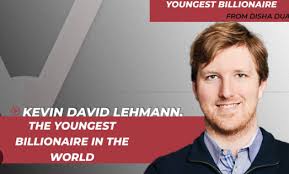
In a world where billionaire status is often accompanied by a relentless media presence, roaring business conquests, and a very public persona, the story of Kevin David Lehmann stands in stark contrast. His name entered the global financial lexicon not with a fanfare of his own making, but through a quiet transfer of wealth that rewrote record books. Overnight, and largely away from the spotlight he consistently avoids, Kevin David Lehmann became Germany’s youngest billionaire, a title he has held with a discretion that is almost unheard of in today’s age of hyper-exposure. His narrative is not one of a self-made tech prodigy in a garage, but a fascinating study in legacy, stewardship, and a deliberate choice to define success on one’s own terms. The enigma of Kevin David Lehmann invites us to explore a different archetype of extreme wealth—one built on pharmacy foundations, familial trust, and a profound desire for a normal life amidst extraordinary circumstances.
The journey of Kevin David Lehmann is inextricably linked to a German retail empire that touches the daily lives of millions: dm-drogerie markt. The ubiquitous drugstore chain, known for its yellow logos and vast array of health, beauty, and household products, is the source of the fortune. Yet, Kevin David Lehmann did not build this empire. His path to unparalleled financial standing began as a teenager, when his father, Günther Lehmann, a reclusive billionaire in his own right, transferred his 50% stake in the dm (dm-drogerie markt) empire to his then-underage son. This monumental shift wasn’t a sudden caprice but a strategic, long-planned move within a family that has always valued privacy over publicity. From that moment, Kevin David Lehmann became the custodian of one of Germany’s most successful retail fortunes, embarking on a life journey that balances the weight of immense responsibility with a personal quest for anonymity and purpose beyond the balance sheet.
The Foundation: dm-drogerie markt and the Source of Wealth
To understand the significance of Kevin David Lehmann’s position, one must first appreciate the colossal enterprise that generates the wealth. dm-drogerie markt is not just a store; it’s a cultural and retail institution in Germany and across Central Europe. Founded in 1973 by Götz Werner, whose philosophy of “acting for the benefit of the customer” became its cornerstone, dm grew from a single store into a powerhouse. Its success is built on a unique blend of a cooperative leadership model, a strong focus on organic and sustainable brands (like its own popular alverde and denkmit lines), and a corporate culture that emphasizes employee development. The company’s growth has been nothing short of phenomenal, boasting thousands of stores and tens of billions in annual revenue.
The ownership structure of this giant has always been private and famously opaque, with ownership split 50/50 between two families: the family of founder Götz Werner and the family of Günther Lehmann, Kevin’s father. Günther Lehmann was the financial and strategic counterpart to Werner’s visionary ideas. A trained businessman, he joined the company early on, providing the capital and business acumen that helped scale dm into the behemoth it is today. Unlike many magnates, Günther Lehmann operated from the shadows, shunning interviews and photographs, a trait he has clearly passed on to his son. His stake in dm, therefore, represents not just a financial investment, but a lifelong partnership in building a retail revolution. It is this legacy—this half-share of a deeply respected and wildly profitable enterprise—that forms the entire bedrock of Kevin David Lehmann’s fortune.
The transfer of this stake was a carefully orchestrated event. It wasn’t a reaction to market conditions or a sudden decision, but part of a long-term estate and succession plan. By placing the shares in a foundation (the David Lehmann Foundation) for the benefit of his son, Günther Lehmann ensured the continuity of the family’s involvement in dm while legally and financially securing his son’s future. This mechanism also served to protect the company itself, shielding it from potential external turbulence and keeping the ownership stable. The move, while private, sent ripples through the financial world when it was eventually disclosed, precisely because of the staggering scale of the wealth involved and the youth of its new beneficiary. It established Kevin David Lehmann not as an active operator, but as a principal owner, a silent partner in one of Europe’s most impressive retail stories.
The Record-Breaking Transfer: Becoming Germany’s Youngest Billionaire
The moment Kevin David Lehmann entered the billionaire ranks was not marked by an IPO or a headline-grabbing product launch, but by a private transaction within a family foundation. While the exact date of the transfer is not public, it occurred when he was still a minor, believed to be in his early-to-mid teens. German law allows for such transfers into foundations for the benefit of minors, and the Lehmann family utilized this structure perfectly. The world at large only became aware of this seismic shift years later, around 2021, when Forbes and other wealth-tracking publications, through their research into ultra-high-net-worth individuals, identified Kevin David Lehmann as the beneficial owner.
The numbers are staggering. Based on conservative estimates of dm-drogerie markt’s value—a company with immense revenue, profitability, and growth potential—the 50% stake places Kevin David Lehmann’s net worth firmly in the multi-billion Euro range. Overnight in the public’s perception, though not in legal reality, a teenager superseded well-known German industrialists and tech founders to claim the title. It’s a record that he continues to hold as he moves through his early twenties, a testament to the sheer size of the enterprise he partially owns.
This transition raises profound questions about inheritance, merit, and preparedness. In an era where “self-made” is often the preferred narrative of the wealthy, Kevin David Lehmann’s story is unabashedly one of inheritance. However, to dismiss it as merely a story of luck would be a vast oversimplification. The wealth did not come without strings or expectations; it came with the immense responsibility of being a steward for a company that employs hundreds of thousands and serves millions of customers. His father, Günther, has been described as ensuring his son was prepared for this reality, instilling in him a sense of duty and an understanding of the business from a young age. The record, therefore, is not just about age and wealth, but about the early assumption of a burden that most people never have to contemplate.
“Wealth brings responsibility. My focus has always been on ensuring the long-term stability and positive impact of the enterprise, not on the personal title.” — A paraphrased sentiment often attributed to the private ethos of the Lehmann family.
The public reaction to the revelation was a mix of awe and curiosity. Headlines focused on his youth, his fortune, and most persistently, the lack of information about him. In a media cycle hungry for personalities, Kevin David Lehmann presented a blank slate—a silhouette where the public craved a face. This very absence became the story, fueling interest in who this young man really was and how he would navigate a life of such extreme financial privilege from its very beginning.
A Life of Anonymity: The Lehmann Family Philosophy
If there is one defining characteristic of Kevin David Lehmann and his father Günther, it is their militant commitment to privacy. In a digital age where every meal and thought can be public currency, the Lehmanns have built a fortress of silence around their personal lives. There are virtually no verified photographs of Kevin as an adult. He has never given a media interview. His educational path is not publicly documented in detail. His hobbies, his friendships, his daily life—all are shielded from public view. This is not an accident or a temporary phase; it is a core family philosophy, a deliberate choice that has been maintained for decades.
This obsession with anonymity is rooted in several factors. Firstly, it is a matter of personal security. Extreme wealth can make individuals and their families targets. By maintaining a low profile, the Lehmanns mitigate very real risks. Secondly, and perhaps more importantly for them, it is about freedom. It is the freedom to live a life unencumbered by constant public scrutiny, to make mistakes in private, to form genuine relationships not influenced by wealth, and to move through the world with a degree of normalcy. For a young man like Kevin David Lehmann, this privacy allows him the space to grow, learn, and develop his own identity separate from the towering shadow of his financial worth.
This philosophy extends to their business dealings. dm-drogerie markt itself is a private company, not required to disclose the minutiae of its operations or ownership. The leadership, including long-time CEO Erich Harsch, operates the company day-to-day, allowing the owning families to remain in the background. This separation between ownership and operational management is key. It allows the company to be run by professionals while the owners focus on long-term strategy and capital allocation through their foundation roles. The Lehmanns believe the company’s success speaks for itself; their personal publicity is unnecessary and potentially distracting.
The commitment to this quiet life is so strong that it has become a defining part of the Kevin David Lehmann narrative. It defies the modern playbook for the ultra-wealthy, which often involves philanthropy announcements, social media presence, or thought leadership platforms. His “brand” is the absence of a brand. This creates a unique paradox: his name is known because of the money, but the person remains a mystery because of the values attached to it. In an era of oversharing, his silence is perhaps the most powerful statement he makes.
Stewardship Over Spotlight: The Role of a Silent Owner
What does it mean to be the owner of a half-share in a vast empire when you are not its CEO or public face? For Kevin David Lehmann, the role is best defined as that of a steward and a guardian. His responsibility is not in stocking shelves or negotiating supplier contracts, but in ensuring the long-term health, values, and direction of the capital that sustains the business and, by extension, the foundation that bears his name. This is a role that requires a different skillset—one of strategic oversight, financial acumen, and philosophical alignment with the company’s core principles.
The primary vehicle for this stewardship is the David Lehmann Foundation (Stiftung). German foundations (Stiftungen) are powerful entities often used for managing large family fortunes, combining corporate ownership with philanthropic goals. Through this foundation, Kevin David Lehmann’s stake in dm is held and managed. The foundation’s board, which likely includes trusted advisors and possibly family members, makes key decisions regarding the holding. This structure provides stability, ensures the shares remain intact and not fragmented through generations, and can direct dividends towards charitable causes, though the specifics of the David Lehmann Foundation’s philanthropic activities are, predictably, not publicized.
His involvement, while not operational, is believed to be more than passive. Given his father’s hands-on history with dm, it is reasonable to assume Kevin David Lehmann is being educated to understand the business at a granular level. This could involve private briefings, reviewing financial and strategic reports, and perhaps discreet visits to stores or logistics centers. The goal is not to micromanage but to be an informed owner who can, when necessary, provide guidance or approval for major strategic shifts, ensuring the company stays true to the values that made it successful while adapting to new retail challenges like e-commerce and digitalization.
This model of “silent ownership” has advantages. It protects the company from the whims of the stock market and short-term investor pressure. It allows management to execute long-term strategies—such as dm’s deep investment in sustainability and employee welfare—that might be difficult for a publicly-traded company to justify quarterly. For Kevin David Lehmann, it allows him to influence a major enterprise meaningfully without having to sacrifice the private life he and his family cherish. He exercises power not through press releases, but through the quiet, sustained influence of committed capital and aligned values.
The Personal Journey: Education, Interests, and Building an Identity
Piecing together the personal journey of Kevin David Lehmann is an exercise in respecting boundaries while acknowledging public curiosity. What little is known or reasonably speculated paints a picture of a young man navigating an unparalleled situation with a desire for normalcy. His education is private, but it is almost certain to have been a meticulous preparation for his future role. This likely involved tutoring in finance, business management, and languages, possibly at elite private institutions in Germany or Switzerland, followed by university studies. The field of study would logically align with economics, business administration, or perhaps even philosophy, given dm’s strong ideological underpinnings.
Beyond formal education, his development would focus on cultivating the judgment and character required of a future custodian of billions. This involves understanding global economics, the history of the retail sector, ethical investment, and the principles of philanthropy. It is a curriculum not found in any standard syllabus, tailored to the unique responsibilities he bears. His father, Günther, is said to be deeply involved in this preparation, ensuring his son inherits not just wealth, but the wisdom to manage it.
As for personal interests, one can only speculate. However, individuals in similar positions often gravitate towards pursuits that offer engagement, challenge, or escape. Given the family’s low-profile nature, these might be private hobbies—perhaps music, sports, technology, or the arts—pursued away from the public eye. The crucial aspect of this personal journey is the construction of an identity. The greatest challenge for Kevin David Lehmann may not be wealth management, but the existential task of answering the question, “Who am I?” outside of the fact of his inheritance. His family’s philosophy of privacy is the tool that gives him the space to do just that: to form friendships, develop passions, and make mistakes without every step being catalogued as “what the billionaire did.”
The coming-of-age of Kevin David Lehmann is therefore a dual process. One is the external, practical preparation for stewardship of the dm fortune and foundation. The other is the internal, personal quest for self-definition. The success of his life will likely be measured, in his own eyes, by how well he balances these two paths: fulfilling his duty to the legacy he was entrusted with while crafting a meaningful, autonomous personal life. It is a tightrope walk few can imagine, undertaken with the world watching, yet knowing almost nothing.
The Business Landscape: dm-drogerie markt in the Modern Era
The value of the asset that Kevin David Lehmann stewards is not static; it is directly tied to the performance and prospects of dm-drogerie markt in a fiercely competitive and rapidly evolving retail landscape. The company faces significant headwinds and opportunities. The rise of pure-play e-commerce giants, changing consumer habits post-pandemic, inflationary pressures, and the relentless demand for digital integration are challenges for every brick-and-mortar retailer. dm has responded with its own aggressive digital strategy, enhancing its online store, click-and-collect services, and app functionality to create a seamless omnichannel experience.
Furthermore, dm’s traditional strengths are becoming ever more relevant. Its commitment to sustainability, organic products, and refill stations aligns perfectly with growing consumer environmental consciousness. Its focus on employee satisfaction and in-store expertise (through its well-trained staff) offers a service level that online platforms struggle to match. The company’s continuous expansion into new markets in Eastern Europe also provides a clear growth trajectory. The strategic decisions made today—on pricing, supply chain, brand portfolio, and market expansion—will directly impact the future valuation of the company and, by extension, the fortune of Kevin David Lehmann.
The ownership structure, with the Werner and Lehmann families, provides a notable advantage in this climate. Freed from quarterly earnings calls, management can make bold, long-term bets. They can invest heavily in store refurbishments, sustainable packaging, or employee training programs with a decade-long return horizon. This patient capital is a rare and powerful asset. For Kevin David Lehmann, as a key part of this ownership, his role is to support this long-term view. His “vote,” exercised through the foundation, is a vote for continuity, for the company’s core values, and for strategies that may not pay off immediately but will secure dm’s place for the next generation.
The following table outlines some of the key competitive factors shaping dm’s future, and by implication, the context of Lehmann’s stewardship:
| Strategic Challenge | dm-drogerie markt’s Response | Implication for Ownership & Value |
|---|---|---|
| E-commerce & Digitalization | Investment in online platform, app, omnichannel services (click & collect, in-store returns). | Requires significant capital expenditure. Long-term play to defend and grow market share. |
| Sustainability & Ethics | Deepening commitment via own brands (alverde), packaging reduction, carbon footprint goals. | Aligns with consumer trends, builds brand loyalty, but may pressure margins in short term. |
| Competition | From discounters (Rossmann, Müller) and online giants (Amazon). | Necessitates constant innovation in price, product mix, and customer experience to maintain edge. |
| International Expansion | Steady growth in CEE markets (e.g., Hungary, Czechia, Romania). | Major source of potential growth, but carries operational and cultural risks. |
| Inflation & Supply Chain | Strategic pricing, supplier partnerships, logistical optimization. | Directly impacts profitability and requires careful navigation to retain price-sensitive customers. |
Philanthropy and the Future: The Potential of the David Lehmann Foundation
While the business of dm is commercial, the potential of the wealth it generates extends far beyond profits. This is where the concept of the David Lehmann Foundation takes on a broader significance. In Europe, and particularly in Germany, family foundations are often conduits for substantial philanthropic activity. Given the scale of the Lehmann fortune, the foundation has the capacity to be a transformative force in areas like social welfare, education, scientific research, or the arts. The critical question is: what will be its focus?
The silence surrounding the foundation’s activities is absolute. However, we can look at the values embedded in dm-drogerie markt for clues. The company is built on a philosophy of supportive leadership (Mitarbeiterführung), fostering potential in people, and a commitment to social and ecological responsibility. It is logical to assume that any philanthropic endeavors from the David Lehmann Foundation would be aligned with these principles. Potential areas could include funding educational initiatives, supporting social enterprises, advancing medical research (particularly in pharmacy-adjacent fields), or environmental conservation projects.
For Kevin David Lehmann, the foundation represents perhaps the most profound tool at his disposal. It is a means to translate financial capital into social capital. While his role in the business is that of a steward, his role with the foundation could be that of a shaper. He has the opportunity, likely alongside his father and advisors, to define a philanthropic legacy. Will it be targeted and hands-on, or broad and endowment-style? Will it operate locally in Germany or have a global reach? The answers to these questions will form a significant part of his life’s work and could become his most visible contribution to society, even if the giving is done quietly.
The future of the foundation is intrinsically linked to the future of Kevin David Lehmann himself. As he matures and gains more direct control over its direction, his personal interests and worldview will inevitably guide its mission. The private young man may one day express his values not through public speeches, but through the strategic allocation of resources to causes he deems worthy. In this way, the foundation could become the primary interface between the private world of Kevin David Lehmann and the public good—a silent engine for change, powered by the success of the yellow dm stores.
The Public Fascination: Why We Can’t Look Away
The story of Kevin David Lehmann captivates precisely because of what we don’t know. In a media-saturated world, he is a living blank space, and human nature abhors a vacuum. We project our own narratives onto him. Is he a reluctant heir, burdened by expectation? A shrewd young mind already plotting the next phase of the empire? A simple young man who just wants to be left alone? The lack of data points allows for all these stories to coexist. This fascination is fueled by the stark contrasts in his narrative: extreme wealth vs. extreme privacy, ultimate privilege vs. the desire for normalcy, immense power vs. zero public voice.
This dynamic speaks to broader cultural questions about wealth, inheritance, and success. His story challenges the “self-made” myth that dominates so much of the business discourse, particularly from Silicon Valley. It forces a conversation about legacy, about the responsibilities that come with generational wealth, and about different models of achieving influence. Furthermore, in an age of influencer culture where personal branding is a currency, his total rejection of that paradigm is both baffling and refreshing. He is an anomaly, and anomalies are inherently interesting.
The media’s role in this is cyclical. The less he reveals, the more intense the periodic attempts to uncover details become. Paparazzi have occasionally managed to capture grainy, long-lens photos, which only serve to heighten the mystery. Financial journalists dig through commercial registers and corporate filings, piecing together the legal and financial architecture that surrounds him, but the human element remains elusive. This dance between secrecy and curiosity is unlikely to end. As Kevin David Lehmann grows older and perhaps takes on a more visible role in his foundations or (though less likely) the business, the spotlight will only burn brighter, testing his and his family’s resolve to maintain their private world.
Conclusion: A Different Kind of Billionaire Story
The narrative of Kevin David Lehmann is a compelling counterpoint to the typical billionaire archetype. It is not a tale of rags to riches, of disruptive innovation, or of charismatic leadership. Instead, it is a story about stewardship, legacy, and the conscious choice to define one’s life away from the public gaze. His wealth, derived from the phenomenal success of dm-drogerie markt, was entrusted to him as a profound responsibility, not just a personal reward. His journey, as much as we can glimpse it, is about growing into that responsibility while fiercely protecting his right to a private identity.
His impact on the world, for now, is channeled through the continued success and ethical operation of a company that touches millions of lives daily and through the quiet, unknown potential of his foundation. The true measure of Kevin David Lehmann’s life may never be a public one. It may be found in the stability and positive culture of a vast enterprise, in the anonymous grants that fund a breakthrough or lift a community, and in the peaceful, self-determined life he manages to carve out for himself against incredible odds. In a world shouting for attention, his silence is his most powerful statement, and his story reminds us that there are many ways to hold power, and many ways to define a life well-lived.
FAQ
Who exactly is Kevin David Lehmann?
Kevin David Lehmann is a German billionaire, known as Germany’s youngest billionaire. He acquired this status after his father, Günther Lehmann, transferred his 50% stake in the dm-drogerie markt drugstore chain to him via a foundation when Kevin was still a minor. He is known for an extremely reclusive lifestyle, with no public interviews or verified adult photographs.
How did Kevin David Lehmann get his wealth?
Kevin David Lehmann’s wealth comes entirely from inheritance. He is the beneficial owner of a 50% stake in dm-drogerie markt, one of Europe’s largest drugstore retailers. This stake was transferred to him through the David Lehmann Foundation, a legal entity set up by his father to manage the family’s holding in the company.
What is the David Lehmann Foundation?
The David Lehmann Foundation is a German family foundation (Stiftung) that holds the Lehmann family’s ownership stake in dm-drogerie markt for the benefit of Kevin David Lehmann. It serves as the vehicle for managing this immense asset, ensuring its long-term stability, and can also be used for philanthropic purposes, though details of its charitable activities are not public.
Why is Kevin David Lehmann so private?
Privacy is a core philosophy of the Lehmann family. They believe it is essential for personal security, freedom, and the ability to live a normal life away from the burdens of public scrutiny. This approach also extends to their business, allowing dm-drogerie markt to operate without the distraction of owner publicity and enabling long-term, patient capital strategies.
What is Kevin David Lehmann’s role in dm-drogerie markt?
Kevin David Lehmann is not involved in the day-to-day operations of dm. His role is that of a silent owner and steward. Through the David Lehmann Foundation, he and its board provide oversight and strategic guidance for the family’s shareholding, ensuring the company’s health and adherence to its core values over the long term, while professional managers run the company.