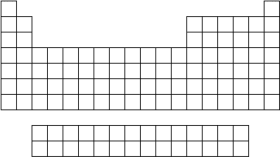
Have you ever stared at the wall chart of elements in a science classroom and felt completely overwhelmed? That colorful, information-dense mosaic can look more like abstract art than a scientific tool to the uninitiated. But what if the key to unlocking its secrets isn’t a completed chart, but an empty one? Enter the humble blank periodic table. Far from just an empty page, a blank periodic table is a canvas for discovery, a powerful educational instrument, and a test of true chemical understanding. Think of it as the ultimate study buddy for chemistry students, the perfect diagnostic tool for teachers, and a surprisingly effective way to visualize one of science’s greatest organizational systems. By starting with the empty structure—just the skeleton of rows and columns—you begin to appreciate the profound logic and beautiful patterns that Dmitri Mendeleev embedded within it over 150 years ago. This guide will take you through everything you need to know about using a blank periodic table to master chemistry, from basic memorization to deep conceptual learning.
The Surprising Power of an Empty Grid: What Is a Blank Periodic Table?
A blank periodic table is exactly what it sounds like: the familiar grid structure of the periodic table, but with the squares for each element left empty. Typically, it maintains the standard 18-column and 7-row layout, with the lanthanides and actinides placed separately at the bottom. The boxes are there, ready to be filled, but they contain no names, no symbols, and no atomic numbers. Sometimes, these tables include the group numbers (the columns, 1-18) and period numbers (the rows, 1-7), and a bold line is often drawn to show the zigzag boundary that separates metals from nonmetals. Other versions are completely bare, offering nothing but the empty cells as the ultimate challenge.
Why would anyone want a table with all the crucial information removed? The power lies in active recall, which is a far more effective learning method than passive review. When you try to populate a blank periodic table from memory, you’re forcing your brain to retrieve information, strengthening neural pathways and moving knowledge from short-term to long-term memory. It transforms the periodic table from a static reference poster into an interactive puzzle. This process mirrors the historical development of the table itself. Mendeleev didn’t have a complete set of data; he had gaps and used the logic of his arrangement to predict what belonged in those empty spaces. Using a blank periodic table puts you in the shoes of a scientist, thinking about relationships and patterns, not just rote facts. It shifts your focus from “What is element 79?” to “Why is element 79 located right here, between these other elements, and what does that tell me about its properties?”
Your Go-To Resource: Finding and Printing the Perfect Template
Getting started with a blank periodic table is incredibly easy, thanks to a wealth of free online resources. For a quick and high-quality option, Science Notes offers a PDF version that is perfectly formatted for standard letter-sized paper (8½ x 11 inches), making it ideal for crisp, clear printing for classroom or personal use. They also provide a PNG image file, which is great for dropping into digital worksheets, presentations, or study guides. For maximum flexibility, especially if you want to create custom digital activities, Wikimedia Commons hosts a scalable SVG (Scalable Vector Graphic) file of a blank periodic table. This file type can be enlarged to any size without losing quality, perfect for creating posters or detailed diagrams. Teachers can incorporate these into their curriculum packets, and students can print as many copies as they need for repeated practice sessions.
When choosing your template, consider your learning goal. Are you just trying to memorize symbols? A completely bare grid might be best. Are you focusing on the separation between metals, nonmetals, and metalloids? Choose a template with the zigzag staircase line already drawn. Planning a color-coding activity for element groups? Ensure the boxes are large enough to shade in. Having multiple versions on hand allows you to progressively increase the difficulty—starting with a table that has atomic numbers only, then moving to one with just the symbols, and finally tackling the fully blank periodic table. This scaffolding approach builds confidence and solidifies the spatial memory of where each element lives.
Transforming Study Sessions: Creative Ways to Use Your Blank Periodic Table
A blank periodic table is the Swiss Army knife of chemistry study tools. Its uses extend far beyond a simple memory quiz. Here’s how different learners can harness its potential.
For the individual student, it’s a personal progress tracker. Regularly challenge yourself to fill in the entire table from memory. Time yourself, track your errors, and watch your speed and accuracy improve over weeks. This isn’t just about naming elements; you can use different copies for different tasks. On one, fill in just the atomic numbers. On another, write in the full element names. On a third, focus only on chemical symbols. To go deeper, try a blank periodic table activity where you color-code the different families: alkali metals in red, halogens in blue, noble gases in green, etc. This visual exercise reinforces group properties. You can even annotate trends directly onto the grid—draw arrows showing how atomic radius increases or decreases across a period or down a group, making the table a dynamic map of chemical behavior.
For teachers, the blank periodic table is an invaluable classroom asset. It can serve as a quiz, a pop quiz, a homework assignment, or a collaborative group project. It provides immediate, visual feedback on what your students know and where the gaps are. More creatively, you can use it for the “Alien Periodic Table” challenge, a fantastic assessment activity. Students are given data on fictional elements from another planet and must use the logical patterns of the table (periodicity) to arrange the alien elements correctly on a blank periodic table. This task assesses true understanding, not just memorization, as students must apply the concepts of groups, periods, and property trends. Another engaging project is having students “Design Your Own Periodic Table.” They select a theme (like sports equipment, types of music, or characters from a book) and organize at least 20 items into a logical, periodic pattern on a blank periodic table grid, explaining their chosen categories and trends. This builds profound appreciation for the organizational genius of the real table.
Beyond Memorization: Building True Chemistry Intuition
The ultimate goal of working with a blank periodic table is to develop a fundamental, intuitive understanding of chemistry. When you can visualize the empty grid and mentally populate it, you start to see the invisible threads that connect the elements.
You begin to comprehend periodicity—the repeating patterns of properties. You understand that an element’s location is a direct result of its atomic structure. For instance, simply by knowing an element is in Group 1 (the first column), you instantly predict it has one valence electron, is highly reactive, and forms +1 ions. You don’t need to look up sodium or potassium; the blank periodic table framework itself tells you this. This predictive power is the table’s greatest strength, a concept formalized in the Next Generation Science Standards (HS-PS1-1), which expects students to “use the periodic table as a model to predict the relative properties of elements”. Filling a blank periodic table repeatedly engrains this model in your mind.
This understanding bridges into practical chemistry. Balancing equations, predicting reaction products, and understanding bonding all become easier when you can quickly infer an element’s behavior from its position. Was the element likely to give away electrons (left side), take electrons (right side, excluding noble gases), or share them (in the middle)? The blank periodic table, once understood, answers these questions at a glance. Activities like the “Periodic People Challenge,” where students arrange cartoon characters with different traits into a logical pattern, directly mimic this process of discovering order from a set of characteristics, laying the groundwork for understanding the real table’s structure.
Conquering the Challenge: Strategies for Filling the Entire Table
Facing a fully blank periodic table can be daunting. Here is a strategic, phased approach to conquering it.
Phase 1: Landmarks and Anchor Points. Start by memorizing key landmarks. Know the first three periods (rows 1-3) cold, as they contain common, frequently referenced elements. Lock in the positions of the first 20 elements. Memorize the entire s-block (Groups 1 and 2) and the p-block main groups (Groups 13-18), particularly the halogens (Group 17) and noble gases (Group 18). Use mnemonics for tricky sequences. For the first 20, a classic is: “Happy Henry Likes Beer But Could Not Obtain Food.” (H, He, Li, Be, B, C, N, O, F).
Phase 2: The Power of Groups and Families. Learn elements not in isolation, but in their vertical families. For example, learn Group 1 (Li, Na, K, Rb, Cs, Fr) as the reactive alkali metals. Group 2 (Be, Mg, Ca, Sr, Ba, Ra) are the alkaline earth metals. Group 17 (F, Cl, Br, I, At) are the halogens. This associative learning is powerful because these elements share chemical properties. You can create a “Personality” for each family, like thinking of the alkali metals as generous “hippies” who give away their one valence electron, or the halogens as greedy “thieves” who want to take one electron.
Phase 3: Tackling the Transition Metals (d-block). This is often the hardest part. Break it down. Memorize the first row of transition metals (Sc through Zn) as a block. Notice patterns within, like the common triads: Fe-Co-Ni; Ru-Rh-Pd; Os-Ir-Pt. For the rest, focus on high-profile elements you encounter often: silver (Ag), gold (Au), mercury (Hg), and tungsten (W).
Phase 4: The f-block (Inner Transition Metals). The lanthanides (rare earth elements) and actinides are usually listed separately. A common strategy is to simply know the first few of each series (La, Ce, Pr, Nd; Ac, Th, Pa, U) and remember that the actinides are all radioactive. For a full memorization challenge, focus on the ones with significant applications, like uranium (U) and plutonium (Pu).
A Tool for Every Level: From Middle School to University
The beauty of the blank periodic table is its scalability. It’s useful at every stage of chemistry education. In middle school or introductory high school courses, it might be used to learn basic names and symbols, or to color-code metals, nonmetals, and metalloids as part of a hands-on lab. At the standard high school level, it becomes a tool for mastering trends: ionization energy, electronegativity, atomic radius, and ionic radius. Students can draw arrows and annotate these trends directly on their filled-in tables. For Advanced Placement (AP) Chemistry or university general chemistry, the blank periodic table challenge becomes more sophisticated. Students might be expected to fill in not just symbols, but also electron configurations, common oxidation states, or even phase (solid, liquid, gas) at room temperature. The “Periodic Table Challenge” website, for example, offers an interactive online version where you type symbols into a blank periodic table against the clock, with automatic grading. This gamifies the process and is perfect for competitive review sessions among peers.
The Digital Revolution: Interactive Blank Periodic Tables
While printable PDFs are classic, the digital world offers dynamic, interactive versions of the blank periodic table that enhance learning. Websites like The Periodic Table Challenge provide an online quiz where you click on a box in a blank periodic table and type the element’s symbol. It grades you in real-time, offers hints after multiple wrong guesses, and even timers you, allowing for friendly competition. This is fantastic for self-paced learning and review. Digital platforms also allow for easier creation of custom activities. Teachers can use tools like Google Slides or digital whiteboards to share a blank periodic table with students, who can then collaboratively fill it in during a live session. Furthermore, creative digital projects, like the “Design Your Own Periodic Table” assignment, encourage students to use graphic design software to populate a blank periodic table template with their chosen theme, blending science with creativity and digital literacy.
“The blank periodic table is not an absence of information, but a space for constructing understanding.” – A foundational concept in chemistry education.
Common Pitfalls and How to Avoid Them
As powerful as the blank periodic table is, learners can fall into common traps. The biggest is relying on passive staring instead of active recall. Looking at a completed table for an hour is less effective than spending 10 minutes actively trying to fill a blank one. Avoid this by always having a stack of blank copies handy and testing yourself frequently.
Another pitfall is learning elements in a random order. Memorizing elements alphabetically (Argon, Arsenic, Astatine…) destroys your spatial memory of the table. Always learn in the context of the grid—by period (row) or, better yet, by group (column).
Finally, don’t neglect the reason behind the location. If you only memorize that iron is Fe at position 26, you’ve missed the point. Understand that it’s a transition metal in Period 4, which tells you about its electron configuration, common oxidation states (+2, +3), and magnetic properties. Connect the fact to the trend. Use your filled blank periodic table as a starting point for asking “why?”
Conclusion: Embracing the Framework for Mastery
The journey from viewing the periodic table as a bewildering chart to seeing it as a logical, predictable framework is one of the most rewarding in science. The blank periodic table is the vehicle for that journey. It demystifies the chart by breaking it down into a fillable, conquerable structure. It transforms learning from a passive act of reception into an active process of construction and discovery. Whether you are a student cramming for a final, a teacher designing an engaging lesson, or a lifelong learner curious about the building blocks of our universe, starting with a blank periodic table is the most effective way to internalize the order, the beauty, and the predictive power of chemistry’s greatest masterpiece. So, print out a copy, grab a pencil, and start filling in the blanks. With each element you place, you’re not just memorizing a fact; you’re building a mental model of the material world.
Frequently Asked Questions (FAQ)
How can a blank periodic table help me more than a completed one?
A completed table is for reference; a blank periodic table is for learning. The act of retrieving information from your memory to fill in the blanks—a process called active recall—strengthens your neural connections far more effectively than passively reading a completed chart. It forces you to engage with the structure and logic of the table, helping you remember not just what the elements are, but where they are and why they are there.
Where can I find a good quality blank periodic table PDF to print?
High-quality, printer-friendly PDFs are readily available online from educational science websites. For instance, Science Notes offers a free blank periodic table PDF formatted for standard letter-sized paper, complete with group/period labels and the metal/nonmetal dividing line. Wikimedia Commons also provides a versatile SVG file that you can scale to any size before printing.
What’s a fun classroom activity using a blank periodic table?
The “Alien Periodic Table” is a classic and engaging activity. Students receive data on elements from an alien world and must use the periodic trends and logic they’ve learned to place these new elements correctly on a blank periodic table. This assesses deep understanding, not just rote knowledge. Another is the “Design Your Own” project, where students create a periodic table for a theme of their choice (e.g., fruits, cars, apps) using the blank grid.
I struggle with the transition metals. Any tips for that section?
Absolutely! Break the d-block (transition metals) into smaller chunks. First, master the top row (Scandium to Zinc, #21-30). Look for memorable triads like Iron-Cobalt-Nickel. Use mnemonics or stories. Focus on the “famous” ones you encounter often: Silver (Ag), Gold (Au), Mercury (Hg). Remember, you don’t necessarily need to memorize every single one in order initially; focus on the pattern that they occupy the “dip” in the middle of the table.
Can using a blank periodic table really help predict chemical properties?
Yes, this is its superpower. Once you internalize the structure of the blank periodic table, you can predict properties based on position. Elements in the same column (group) have similar properties. For example, knowing fluorine (F) is a highly reactive gas in Group 17, you can predict that chlorine (Cl), below it, will also be a reactive (though slightly less so) gas. The table’s layout is a direct map of electron configuration, which dictates reactivity, bonding, and more.