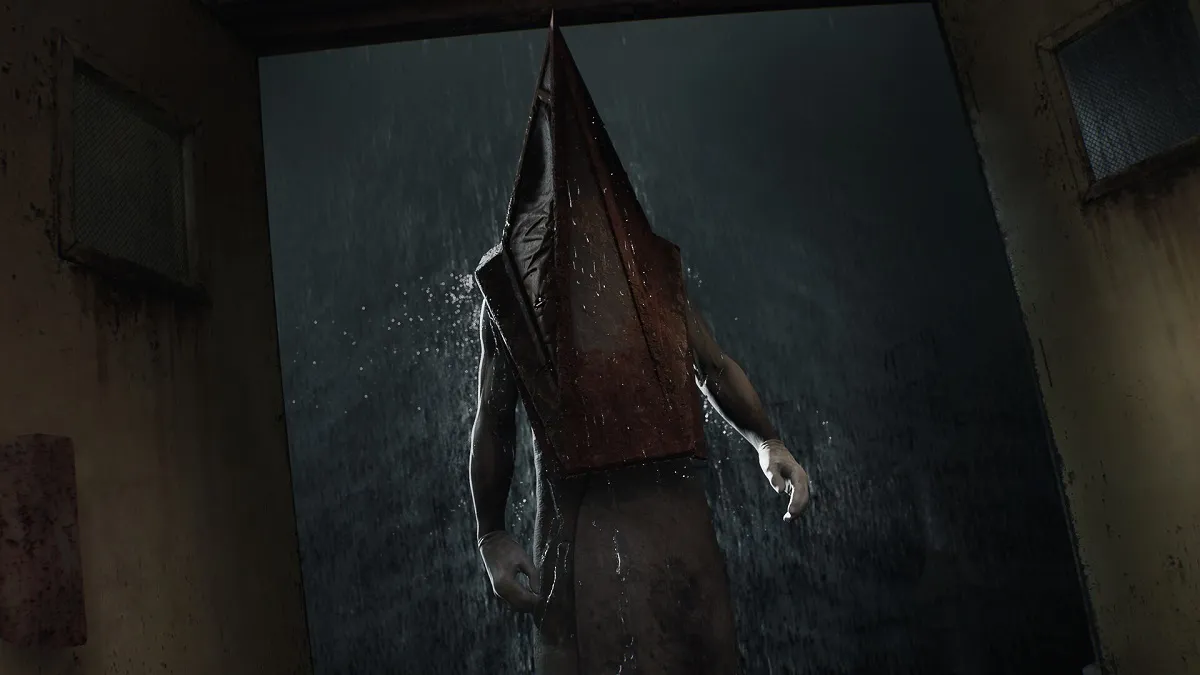
There are few figures in the realm of video games that command the same level of dread, fascination, and sheer iconic status as Pyramid Head. This lumbering, grotesque entity, with his stark white skin, blood-stained apron, and the massive, rusted metal triangle where a head should be, has haunted the nightmares of players since his debut in 2001. He is more than just a monster; he is a symbol, a psychological manifestation, and arguably the true face of the Silent Hill franchise. For many, the mention of survival horror instantly conjures images of this executioner dragging his incomprehensibly large Great Knife through fog-drenched, decaying corridors .
Understanding Pyramid Head requires looking beyond his terrifying exterior. He is not a villain in the traditional sense, driven by malice or a desire for world domination. Instead, he is a being born from guilt, repression, and the need for punishment. He is the physical embodiment of protagonist James Sunderland’s inner turmoil in Silent Hill 2, a role that grounds the horror not in jump scares, but in profound psychological dread . The town of Silent Hill is a deeply personal space, reflecting the darkest corners of the souls who enter it, and Pyramid Head is the most potent example of this phenomenon. He is the judge, the jury, and the executioner, all wrapped into one impossibly strong, silent form .
To the uninitiated, he is simply a nightmare given form. To those who have walked the foggy streets of Silent Hill, he is a mirror reflecting the sins of the past. His legacy has grown far beyond his original game, appearing in films, other video games, and becoming a permanent fixture in horror iconography. But to truly appreciate the weight of the helmet he carries, we must delve deep into his origins, his symbolism, and the mind of the man who created him. This is the definitive guide to understanding Pyramid Head.
The Birth of a Nightmare: Origins and Design
Every iconic character has a story, and the genesis of Pyramid Head is as unique as his appearance. He was brought to life by Masahiro Ito, the creature designer for Silent Hill 2, who had a very specific goal in mind: he wanted to create a monster with a hidden face. Ito found that his initial designs, which simply featured masked figures, were unsatisfying because they were ultimately just men in masks. To achieve a truly unsettling and non-human aesthetic, he needed to push the concept further .
The breakthrough came from an unexpected source: the 1995 film Braveheart. Ito drew inspiration from the appearance of an executioner in the movie, which featured a hooded figure. This sparked the idea of basing the character on a historical executioner. He then refined this concept by referencing various films and books depicting executioners with bagged heads, solidifying the idea of a figure from an old town’s grim history . The final piece of the puzzle came from Ito’s own art student days. A series of his paintings from 1993 to 1996, titled “Strange head,” featured abstract shapes on human figures. The very first image in this series, a simple, sharp, red triangle atop a body, was the direct visual inspiration for the helmet .
The design itself is a masterclass in symbolic horror. The helmet, a massive, rusted iron pyramid, is not just for show. Ito intended the sharp, acute angles to suggest the very possibility of pain . The color red evokes blood, violence, and punishment. His body is pale, muscular, and deformed, covered in a white, blood-soaked robe reminiscent of a butcher’s smock, tying him to the gruesome act of butchery and execution . Even his primary weapon, the Great Knife, is an absurd and terrifying tool. Weighing approximately 330 pounds, it is a slab of rusted metal that he drags behind him, the deafening screech on the ground serving as an auditory herald of his approach—a sound that has become as iconic as his look . Every element of his design, from the stitch marks on his gloves to the way he moves, was carefully chosen to create an aura of inescapable judgment and brutal, archaic justice .
The Symbolism: Why Does Pyramid Head Exist?
To understand Pyramid Head is to understand the core theme of Silent Hill 2: guilt. The town of Silent Hill does not create monsters at random. It summons them from the subconscious of those who enter, pulling their darkest secrets and deepest shames into physical form. For James Sunderland, a man who secretly murdered his terminally ill wife, Mary, his guilt is the overwhelming force that shapes his reality. Pyramid Head is the avatar of that guilt .
He is, as the game’s supplementary materials and Ito himself have stated, the manifestation of James’s desire for punishment . James feels he has committed an unforgivable sin, and his psyche, warped by the town’s power, creates an entity to exact that penalty. This is why Pyramid Head is relentless in his pursuit of James. He doesn’t just want to kill him; he wants to make him suffer, to force him to confront the truth of his actions. The creature’s historical basis as an executioner in the town’s past—figures who wore triangular red hoods to dehumanize themselves during hangings and “穿刺刑” (impalement)—is a memory from the town that James’s subconscious latches onto to give his punishment a form .
Furthermore, Pyramid Head plays a crucial role in forcing James to accept reality. This is most clearly demonstrated through his repeated torture and murder of Maria, a mysterious woman James meets who is the spitting image of his dead wife. Maria represents James’s fantasy—a version of Mary who is healthy, sexual, and alive. By brutally killing Maria in front of James, Pyramid Head is systematically destroying this illusion. Each time Maria dies, the fantasy is weakened, and the truth of Mary’s death becomes more unavoidable . The creatures are not simply agents of punishment, but also of a harsh, violent therapy. They are an externalized part of James’s own mind, desperately trying to make him acknowledge his crime so he can finally process it and move on. This is why, at the end of the game, when James finally accepts what he has done and no longer requires punishment, the two Pyramid Heads turn their weapons on themselves. Their purpose is fulfilled .
Encounters with the Executioner: A Walkthrough of Terror
James Sunderland’s journey through Silent Hill is punctuated by a series of harrowing encounters with Pyramid Head, each one escalating in tension and symbolic weight. These are not just boss fights; they are key narrative beats. In the original Silent Hill 2 and its highly anticipated 2024 remake, these encounters have been meticulously crafted to maximize dread .
The first encounter is more of an introduction. Inside the Wood Side Apartments, James peers through a grated door and witnesses Pyramid Head brutally assaulting a pair of Mannequin monsters. This scene establishes him as a predator, a force of nature that even the other monsters fear. He is aware of James but does not attack, setting the stage for the psychological torment to come . The second encounter, in the Blue Creek Apartments, is the first real boss fight. James enters a room filled with cages, and Pyramid Head descends upon him. In the remake, this fight is a tense cat-and-mouse game where players must survive for a set amount of time. Crucially, you cannot kill him here. Attacking him only shortens the timer, teaching players that he is not an enemy to be defeated, but a force to be endured .
Later encounters become more aggressive and disturbing. In Brookhaven Hospital, he briefly appears to knock James through a railing, a sudden and violent interruption. Perhaps the most infamous encounter is the corridor scene. As James and Maria run from him, Pyramid Head stalks them slowly. James makes it to an elevator, but the doors close before Maria can enter. He is forced to watch through the small window as the monster grabs her and brutally ends her life, a traumatic event that solidifies his role as a punisher . The final confrontation is the most surreal. Deep in the Labyrinth, James finds himself in a room with not one, but two Pyramids Head. They corner him, but instead of attacking, they impale Maria (who has reappeared) on their spears. After a brief moment, they turn and, in a shocking act of self-destruction, drive their spears into their own bodies, finally disappearing from James’s life for good .
Mastering the Fights: Tips for Survival
Facing Pyramid Head is a test of nerve. Here are key strategies for surviving your encounters with him in the Silent Hill 2 Remake:
- Prioritize Dodging: His attacks are slow but devastating. Master the timing of your dodge to avoid his overhead chop and horizontal sweeps. If he attempts his grab attack, dodge to the right .
- Distance is Your Friend: He is a melee-focused enemy. Use the environment to create space. While he can smash through obstacles, it buys you precious seconds to aim or reload .
- Weapon Choice: The Hunting Rifle is highly effective, allowing you to deal damage from relative safety. In the first boss fight, remember that dealing damage only speeds up the timer; it’s often wiser to save your ammunition .
- Listen Carefully: The sound of his Great Knife scraping along the floor or the ground is your best warning system. If you lose sight of him in the darkness or fog, listen for that dreaded screech .
Evolution of a Monster: Appearances Beyond Silent Hill 2
Despite the clear and direct intention of his creator that Pyramid Head is a being unique to James Sunderland’s story, his iconic design proved too powerful to remain confined to a single game. He has since appeared in numerous other Silent Hill titles, films, and even crossed over into entirely different gaming universes, much to the chagrin of Masahiro Ito, who has expressed regret over his creation being reused outside of its original context .
In the Silent Hill films, he was reimagined as “Red Pyramid.” Director Christophe Gans and designer Patrick Tatopoulos altered his physique, making him taller and more statuesque, like a demonic warrior god, to fit the film’s broader narrative of a town cursed by a cult. Here, he serves as a guardian for the character Alessa, a shift from a personal psychological symbol to a more general agent of the town’s will . The 2008 game Silent Hill: Homecoming introduced a variant called “Bogeyman.” This version is tied to the town’s folklore, a myth used to scare children, and appears to execute the protagonist’s father .
Beyond the core series, Pyramid Head has made some truly surprising cameos. He has appeared as a playable character in the surprisingly cheerful New International Track & Field, as “Pyramid Bomber” in Super Bomberman R, and even as a menacing killer in the multiplayer horror game Dead by Daylight, where he is aptly named “The Executioner” . These appearances, while often fun for fans, strip him of his deep psychological meaning, transforming him into a generic horror icon—a testament to the power of his design, but a dilution of his profound symbolic weight.
| Appearance | Title/Role | Key Characteristics |
|---|---|---|
| Silent Hill 2 (2001 & Remake) | The Executioner / Red Pyramid Thing | James Sunderland’s personal manifestation of guilt. Wields Great Knife and spear. |
| Silent Hill: Homecoming (2008) | Bogeyman | A town myth/folklore figure. Has a more mechanical, armored design. |
| Silent Hill (2006 Film) | Red Pyramid | Alessa’s guardian. Taller, more physically imposing, with a different helmet shape. |
| Dead by Daylight (2020) | The Executioner | A playable killer from a realm of torment, using his powers to hunt survivors. |
| Crossover Titles | Super Bomberman R, New International Track & Field | A decontextualized cameo, often used for his iconic visual appeal. |
Cultural Impact: Why We Can’t Look Away
The legacy of Pyramid Head extends far beyond the Silent Hill franchise. He has secured his place as one of the most iconic and unforgettable figures in video game history, frequently appearing on lists of the scariest monsters ever created . His impact stems from a perfect storm of masterful design, deep psychological resonance, and the terrifyingly blank slate of his “face.” He is a Rorschach test for fear; we project our own anxieties onto that featureless red triangle.
Unlike slasher villains with expressive masks or clear motivations, Pyramid Head’s utter silence and lack of visible emotion make him profoundly disturbing. He is an unstoppable force of nature, a moving statue of guilt and punishment. The sound of his knife scraping on the ground is enough to instill panic in anyone who has played Silent Hill 2. He represents a more sophisticated form of horror, one where the monster is not an external threat but a part of the protagonist himself. This psychological depth has been analyzed and celebrated by fans and critics alike, elevating him from a simple enemy to a piece of interactive art .
His image has become a shorthand for disturbing, high-concept horror in video games. Cosplayers meticulously recreate his look, artists produce countless interpretations, and his silhouette is instantly recognizable even to those who have never played a Silent Hill game. He is a symbol of the medium’s potential to create complex, symbolic characters that resonate on a deeply personal level. As one fan on a 3D modeling site put it, “Pyramid Head is a scary and important character in the Silent Hill games, and he has found a special place in the video game industry due to his unique design and interesting personality” . He is a reminder that the most terrifying monsters are not always the ones that jump out from the shadows, but the ones that force us to look within.
“The inspiration for the background of Pyramid Head from SH2 as the executioner. From a film Braveheart.”
— Masahiro Ito (@adsk4)“Pyramid Head’s existence is described by James as a manifestation of his guilt and a need to ‘punish [him] for [his] sins'”
— Destructoid
Conclusion
Pyramid Head stands tall and terrible as a masterpiece of horror creation. He is far more than a boss to be defeated; he is a walking, breathing symbol of guilt, a manifestation of the human psyche’s capacity for self-destruction and its desperate need for atonement. From his origins in the historical executioners of a fictional town and a background character in Braveheart, to his refined design by Masahiro Ito, every aspect of his being was crafted to evoke a specific kind of dread—the dread of facing oneself . His slow, deliberate gait, his crushing weapon, and his utterly blank expression combine to form an enemy that is as thought-provoking as he is terrifying.
While his presence in later games and media has diluted his original, deeply personal meaning, it has also cemented his status as the face of Silent Hill. He is the monster that players love to fear, a figure whose legacy is built on the foundation of one of the most powerful stories ever told in the medium. Whether he is serving as a personal executioner for a guilt-ridden widower or a guardian in a Hollywood film, Pyramid Head remains an enduring icon of horror. He is a grim reminder that the fog of Silent Hill hides not just monsters, but the truth, and that the only way to escape is to confront the executioner within.
Frequently Asked Questions about Pyramid Head
Q1: What is Pyramid Head’s real name?
While universally known as Pyramid Head, his official name in the game’s credits and supplementary materials is “Red Pyramid Thing” (赤い三角頭). In Japan, he is often called “Sankaku Atama” (Triangle Head), and in Silent Hill: Homecoming, a similar entity is referred to as “Bogeyman” .
Q2: Why does Pyramid Head have a triangle on his head?
The triangle is a core part of his design as a symbol of pain and judgment. Masahiro Ito, his creator, wanted a monster with a hidden face and felt that the sharp, acute angles of a pyramid suggested the possibility of pain. The shape is also directly tied to the historical executioners of Silent Hill, who wore red triangular hoods during executions .
Q3: Can you kill Pyramid Head?
In Silent Hill 2, you cannot permanently kill Pyramid Head until the very end of the game. In your first boss fight with him, he is invincible, and the encounter is on a timer. He only ceases to exist when James finally accepts the truth about his wife’s death. At that moment, the two Pyramid Heads impale themselves with their spears, as they are no longer needed .
Q4: Why does Pyramid Head kill Maria?
Pyramid Head kills Maria repeatedly to shatter James’s delusions. Maria is a fantasy figure, a healthy and vibrant version of his dead wife, Mary. By brutally murdering her in front of James, Pyramid Head is forcing him to confront the reality that Mary is gone and that his fantasy is a lie. It is a violent but necessary act to make James accept his crime .
Q5: Is Pyramid Head in every Silent Hill game?
No. Pyramid Head was created specifically for James Sunderland’s story in Silent Hill 2. While he has appeared in other games like Silent Hill: Homecoming and Silent Hill: Arcade, as well as the films, his creator, Masahiro Ito, has stated that these appearances are not canon to his original character and that he exists only as part of James’s psyche .
Q6: How do you beat Pyramid Head in the first fight of the remake?
In the Silent Hill 2 Remake, the first real fight with Pyramid Head in the apartment building is a timed encounter. Your goal is to survive. You cannot kill him. Attacking him will shorten the time you need to wait, but it costs precious ammunition. If you are confident in your dodging skills, it is often best to simply run and avoid his attacks until the room collapses and the fight ends .