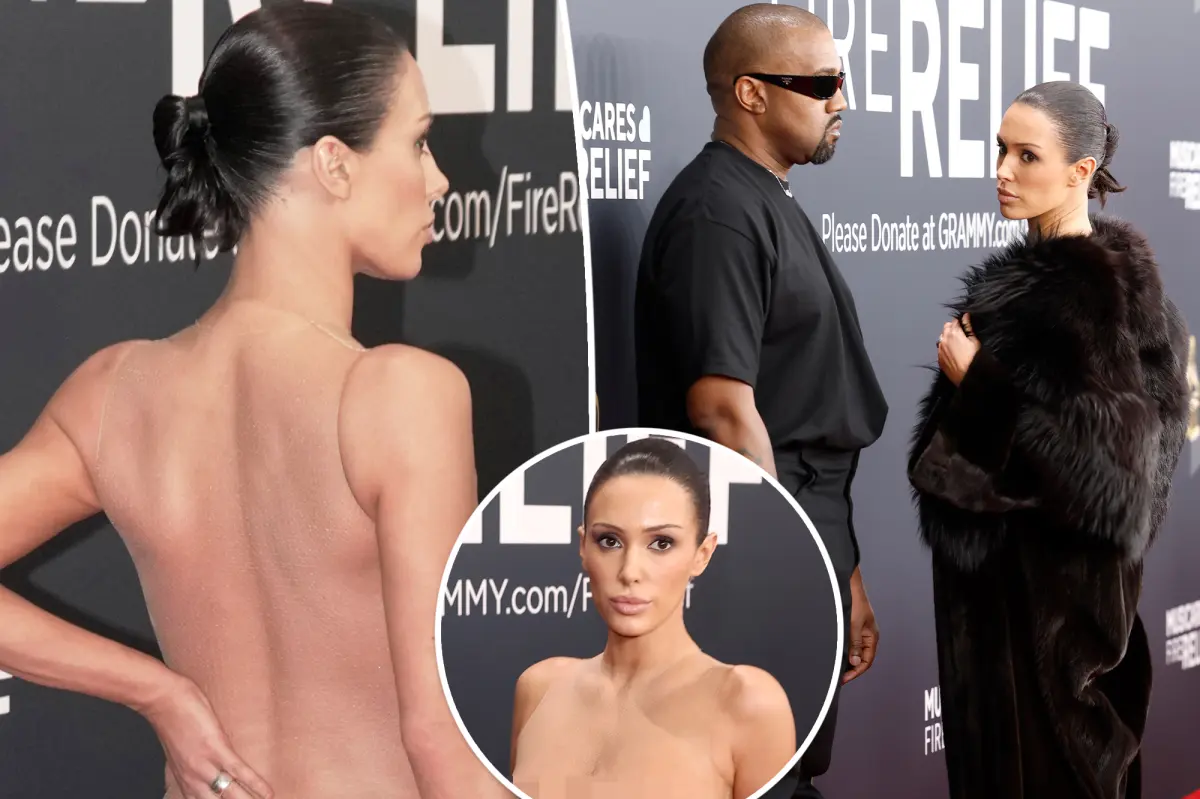
The 2025 Grammy Awards witnessed a moment that would dominate cultural conversations for years to come. As a stoic Kanye West looked on, his wife, Australian architect and artist Bianca Censori, shed a luxurious black fur coat on the red carpet to reveal a sheer, skin-tight mesh bodysuit that left nothing to the imagination. In an instant, the evening’s focus on musical achievement shifted dramatically. This single act—a choreographed reveal of near-total nudity—ignited a firestorm of debate that transcended fashion criticism. It forced conversations about agency, artistry, marital control, and the very purpose of a red carpet, establishing “Bianca Censori Grammys outfit” not merely as a bold fashion choice but as a complex cultural Rorschach test. The controversy was so potent that it cast a long shadow over the following year’s event, with critics using her name as a benchmark for audacity, as seen when one commentator remarked of a 2026 look, “Not even Bianca Censori would wear this”. More than a year later, Censori broke her long-held silence in a revealing interview with Vanity Fair, offering her own narrative and framing the stunt as the culmination of a deliberate, personal “obsession with nudity” and a performance art project. This article delves into the many layers of that infamous Grammy moment: the immediate shockwave, the troubling context of West’s history, the subsequent ripple effect on fashion, and Censori’s own explanation, piecing together the naked truth behind one of the most talked-about red carpet appearances in history.
The 2025 Grammys Moment: A Calculated Reveal
The scene unfolded with a theatrical precision that suggested it was far from spontaneous. Bianca Censori arrived at the Crypto.com Arena wrapped in a voluminous black fur coat, an image of opulent glamour. Beside her, Kanye West (now known as Ye) was clad in a simple, head-to-toe black outfit. As cameras flashed, Censori, under what was widely interpreted as a directive from West, dropped the coat to the ground. The reveal was a second-skin mesh leotard, so transparent it amounted to public nudity, contrasting starkly with her fully clothed husband. The visual dichotomy was jarring and instantly problematic for many viewers. The image of a clothed man orchestrating the exposure of his partner’s body sparked immediate discomfort and criticism across social media and news outlets. The act was interpreted by many as a power play, a literal and figurative unveiling that positioned Censori as an object rather than an agent.
Public reaction was swift and polarized. The internet erupted with a mix of outrage, concern, and crude fascination. Many expressed disgust, calling the display “disturbing” and criticizing it as indecent exposure, especially for a televised event where viewers, including children, had not consented to such imagery. Others framed their concern around Censori herself, interpreting her stone-faced expression as discomfort or a lack of autonomy. Comments like, “He treats her like a puppet. Someone needs to save her from Kanye,” flooded social platforms, reflecting widespread worry that this was an act of spousal coercion rather than self-expression.Bianca Censori Grammys Outfit However, the couple achieved their likely goal: dominating the news cycle. In a strategic move following the event, Ye reportedly made a version of the sheer Grammy leotard available for purchase on his Yeezy website, commercializing the controversy and fueling the perception that the entire episode was a promotional stunt. The stunt was so effective that Censori ended 2025 as the most Googled woman in the world, a fact she later acknowledged with a hint of pride, noting the unique “visibility without speech” she had achieved.
Context and History: A Pattern of Control and Controversy
To understand the depth of the public’s concern, one must look at the context provided by Kanye West’s well-documented history. The Grammy reveal did not occur in a vacuum; it was the latest act in a long-running narrative of West attempting to control the image and wardrobe of his partners. His ex-wife Kim Kardashian famously allowed him to purge her entire closet early in their relationship, an event televised on Keeping Up with the Kardashians. His former partner, Julia Fox, wrote in her memoir about feeling like a “show monkey” during their time together. Amber Rose, another ex, explicitly connected Censori’s style to West’s patterns, stating, “Kanye is for sure dressing her like that. Yeah, he did the same thing to me and Kim… He wants other men to want his woman”. This established history made it difficult for the public to view Censori’s Grammys outfit as an independent choice.Bianca Censori Grammys Outfit
Furthermore, Ye’s broader behavior created a backdrop of deep unease. In the years leading up to the 2025 Grammys, he had been engulfed in scandals involving antisemitic rants, allegations of degrading treatment and sexual harassment of employees, and a volatile public persona. For many, the image of a nearly nude Censori alongside him became a symbol of this toxicity—a shocking spectacle designed to deflect from or dominate over his other controversies. As one analysis put it, the stunt allowed the “once-cancelled figure [to] dominate headlines again by using his partner’s body”. Censori’s complete public silence only amplified these concerns. Unlike the media-savvy Kim Kardashian or outspoken Julia Fox, Censori offered no interviews, no explanations, and no social media captions to provide insight into her motivations. This vacuum of her own voice left the public, and commentators, to speculate based solely on West’s history and the jarring imagery, leading many to conclude she was a controlled “victim and hostage,” as Meghan McCain bluntly stated.
The 2026 Echo: Censori’s Legacy on the Red Carpet
The impact of Bianca Censori Grammys outfit was palpably felt at the very next ceremony. While Censori herself was absent from the 2026 red carpet, her ghost haunted the event, serving as a new benchmark for red carpet audacity and revealing fashion. The shadow of her controversy was long, with critics and fans alike using her name as a shorthand for extreme, barely-there style. This was most explicitly seen in the reaction to supermodel Heidi Klum’s appearance. Klum arrived in a flesh-toned, molded latex dress that gave the illusion of nudity, complete with exaggerated anatomical details. The immediate reaction online drew a direct line back to Censori, with fans dubbing the look “Bianca Censori, 2026 Edition”. The comparison was so potent that in a separate roundup of the year’s most daring looks, a critic remarked of another outfit, “Not even Bianca Censori would wear this”, cementing her status as the extreme boundary against which all other revealing looks were measured.
The 2026 Grammys red carpet itself appeared to operate in a post-Censori landscape, where the threshold for shock had been permanently raised. A parade of celebrities embraced sheer fabrics, strategic cutouts, and lingerie-inspired aesthetics that pushed decency norms. The table below highlights how several 2026 looks seemed to exist in dialogue with the precedent set the previous year.
Table: Echoes of a Precedent: 2026 Grammys Looks in the Shadow of Censori
| Celebrity | 2026 Outfit Description | Parallel to Censori’s 2025 Look |
|---|---|---|
| Chappell Roan | Sheer maroon gown suspended from faux nipple rings. | Focus on sheer fabric and explicit, unconcealed nudity. |
| Heidi Klum | Molded latex dress creating a perfect illusion of nakedness. | The ultimate “nude illusion,” making the body itself the garment. |
| Teyana Taylor | Custom bronze dress with dramatic cutouts exposing breasts and abs. | Architectural cutouts replacing sheer fabric for a similar revealing effect. |
| Zara Larsson | Two-piece set with an asymmetrical bra top and low-waisted skirt. | Lingering on lingerie-as-outerwear, a theme in Censori’s wardrobe. |
This shift demonstrates how a single, extreme act can recalibrate an entire industry’s understanding of what is possible or acceptable on the red carpet. Bianca Censori Grammys Outfit, whether praised or condemned, functionally expanded the Overton window of fashion risk, giving other celebrities a new reference point for audacity. As one fashion commentator noted, the red carpet had entered an era where the goal seemed to be to come “naked,” a destination Censori had already reached.
https://headlinenest.com/lucy-letby/
Censori Speaks: The Vanity Fair Interview and Claiming Agency
For over a year, the narrative surrounding Bianca Censori Grammys outfit was written by spectators, critics, and Ye’s own history. In February 2026, Censori radically shifted that narrative by breaking her silence in a landmark interview and photoshoot with Vanity Fair. In her first major public comments, she forcefully rejected the victim narrative and framed her years of nudity as a conscious, self-directed performance art project. “I had an obvious obsession with nudity,” she stated. “I was naked everywhere. I didn’t detach with it at any point. I consistently showed the same imagery over and over and over again”. She presented the Grammys reveal not as a moment of coercion but as the deliberate “climax” of this artistic endeavor.
Crucially, Censori addressed the central question of control head-on. She insisted on her own autonomy and framed her collaboration with Ye as that of two creative partners. “I wouldn’t be doing something I didn’t want to do,” she asserted. She described their process: “Me and my husband would work on my outfits together. So it was like a collaboration, it was never ‘I was being told to do something.'”. She even offered a provocative analogy to deflect criticism: “If you were married to Gianni Versace, wouldn’t he give you a dress or something?”. This was her attempt to reframe Ye not as a controller, but as a renowned designer-husband collaborating with his muse. Her explanation for her prior silence was equally pointed: “Demanding me to speak is a form of control in itself”. She revealed that the intense scrutiny of 2025 led her and Ye to seek separate in-patient treatment, a period she described as emotionally akin to “doing CPR for months”.
The interview also tackled Ye’s controversies directly. Censori denied being antisemitic and discussed supporting Ye through his struggles, including his meeting with a rabbi.Bianca Censori Grammys Outfit When asked about the sexual misconduct allegations against him, she offered a defense rooted in a controversial view of artistic license: “That’s some people’s path. You have to respect that some people, that’s what they need to do”. While her statements aimed to reclaim her narrative, they did not universally resolve public doubts. For every person who accepted her explanation of empowered artistry, another saw the interview as a sophisticated performance scripted within the very dynamic of control she was denying. The core question remained: Can a performance of submission and exposure ever be truly separated from the potential reality of it?
The Broader Cultural Conversation: Art, Exploitation, and the Female Body
The debate over Bianca Censori Grammys outfit taps into deep, ongoing cultural tensions about female autonomy, the male gaze, and the line between art and exploitation. On one side of the argument is the fundamental principle of bodily autonomy. As the Vogue analysis conceded, “a woman can wear whatever she wants… A woman can court the male gaze… and still not have that mean she’s being coerced”. From this perspective, dismissing Censori’s choices as solely the product of male control is itself patronizing, denying her the agency to use her body as a canvas for provocation or statement. Her own words now firmly plant her flag in this camp, defining her life as her art.
However, the counter-argument insists that context and power dynamics cannot be ignored. Feminism has long grappled with the distinction between empowerment that serves the self and performance that ultimately serves patriarchal structures. The specific context of Censori’s relationship—with a partner known for controlling women’s style and embroiled in misogynistic and antisemitic scandals—makes it difficult for many to view her nudity as purely liberatory. The quote from Amber Rose is particularly damning in this regard, suggesting West’s motivation is about displaying his “property” to incite envy in other men. This frames Censori’s exposure not as self-expression, but as an expression of West’s ego and dominance.
The conversation also exposes a rift in how we interpret red carpet fashion. Traditionally, it’s a space for celebrities to showcase high fashion and personal style, often in celebration of professional achievement. Censori’s Grammys outfit, and her subsequent explanation, challenged this. She was not there as a nominated musician but as an artist using the platform’s immense visibility for a stunt. This blurred the lines between a fashion moment, a marketing ploy for Yeezy, and a piece of performance art. It forced the audience to ask: What is the red carpet for? Is it a celebration of craft, a personal branding opportunity, or a legitimate public stage for avant-garde artistic expression? Censori’s act suggested it could be all three, leaving the public to wrestle with the uncomfortable intersections of commerce, art, and personal relationship dynamics playing out on a global stage.
The Lasting Impact and Unanswered Questions
The legacy of Bianca Censori Grammys outfit is multifaceted. In the immediate sense, it succeeded as a spectacle, making her one of the most visible women on the planet without her uttering a single public word. Its shock value irrevocably influenced the fashion landscape of the following year’s awards season, as evidenced by the daring, Censori-referencing looks at the 2026 Grammys. Commercially, it served its purpose for the Yeezy brand, translating viral attention into a sellable product. As a piece of controversy, it provided a focal point for discussions about celebrity, marriage, and mental health that extended far beyond fashion magazines.
Yet, the most significant impact may be philosophical. The episode laid bare the limits of public perception in the face of deliberate ambiguity. Censori’s long silence was a powerful tool—it allowed a single, shocking image to become a canvas onto which millions projected their own beliefs about agency, abuse, love, and art. Her eventual explanation in Vanity Fair provided an answer, but not necessarily the answer. It offered an artistic manifesto that some will accept as truth and others will view as a well-crafted chapter in the same performance. This leaves us with enduring questions about the nature of choice within highly asymmetric relationships, the ethics of using a life partner as a primary medium for one’s art, and the point at which public concern for a stranger’s well-being becomes its own form of intrusive projection.
FAQs
What exactly did Bianca Censori wear to the 2025 Grammys?
Bianca Censori arrived at the 2025 Grammy Awards wearing a large black fur coat. On the red carpet, she dropped the coat to reveal a sheer, skin-tight mesh bodysuit that was completely see-through, leaving her virtually nude in front of the cameras. This choreographed reveal, with her fully clothed husband Kanye West beside her, became the defining controversy of the event.
Why were people so concerned about her Grammys outfit?
Public concern extended beyond fashion critique for several key reasons. First, Kanye West has a documented history of controlling his partners’ wardrobes. Second, the power dynamic of a clothed man orchestrating the nudity of his silent partner was viscerally troubling to many. Third, it occurred amid West’s other severe controversies, making the stunt seem like a shock tactic to divert attention. People were concerned the Bianca Censori Grammys outfit was a sign of coercion, not choice.
How did the 2025 outfit influence the 2026 Grammys red carpet?
Censori’s 2025 look became a new benchmark for red carpet audacity. At the 2026 Grammys, her name was repeatedly invoked by critics and fans to describe or critique daring looks. Most notably, Heidi Klum’s illusion-of-nudity latex dress was widely dubbed the “Bianca Censori, 2026 Edition”. The overall trend toward sheer, revealing fashion on the 2026 carpet operated in the shadow of the precedent Censori set the year prior.Bianca Censori Grammys Outfit
What did Bianca Censori finally say about the outfit and the controversy?
In her first major interview with Vanity Fair in February 2026, Censori broke her silence. She reframed her years of nudity as a deliberate performance art project, calling the Grammys moment its “climax”. She claimed full autonomy, stating, “I wouldn’t be doing something I didn’t want to do,” and described her looks as a “collaboration” with Ye, not a command. She also revealed the personal toll, comparing supporting Ye through his controversies to “doing CPR for months”.Bianca Censori Grammys Outfit
Where can you buy the outfit Bianca Censori wore to the Grammys?
Following the 2025 Grammys, Kanye West reportedly commercialized the controversy by making a version of the sheer bodysuit Censori wore available for purchase on his Yeezy brand’s website.Bianca Censori Grammys Outfit This move strongly supported the interpretation that the red carpet stunt was, at least in part, a promotional tactic for his fashion brand.
Conclusion
The story of Bianca Censori Grammys outfit is a modern parable about image, interpretation, and the elusive nature of truth in the celebrity age. It began as a shocking visual—a woman baring her body on a global stage under the gaze of her controversial husband. It spiraled into a complex debate encompassing feminism, art, mental health, and marital dynamics, fueled by Censori’s own strategic silence. Her eventual explanation in Vanity Fair provided a coherent, artistic framework for her actions, championing autonomy and creative expression. Yet, for a public aware of the deeply troubling context, her words did not fully settle the matter. Instead, they added another layer to the performance. Ultimately, the Bianca Censori Grammys outfit stands as a powerful reminder that in our image-saturated culture, what we see is never just a dress. It is a statement, a question, and a mirror reflecting our own assumptions about power, freedom, and the stories we choose to believe.