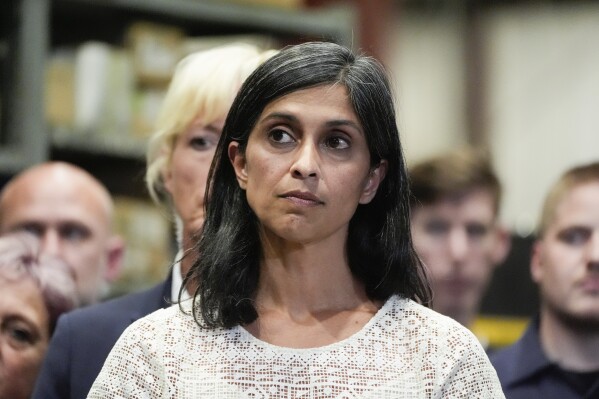
Usha Vance has become one of the most intriguing and significant public figures in modern American politics. As the Second Lady of the United States, her story represents a series of “firsts”: she is the first Indian-American, the first person of Hindu faith, and the first Asian-American to hold this role. Yet, her journey is far more than a collection of milestones. It is a deeply human narrative about identity, belief, love, and public duty that resonates with millions. In a nation constantly redefining its identity, Usha Vance stands at a fascinating crossroads. Her life weaves together a rich Hindu heritage, an elite legal career, and a partnership with one of the nation’s most prominent Christian political figures. The public’s fascination with Usha Vance religion centers not just on her personal devotion but on what her presence signifies for American pluralism, interfaith families, and the evolving image of political leadership. Her story compels us to examine how faith is lived, negotiated, and celebrated in the most public of arenas.
The Spiritual Foundation of a Modern American Story
Usha Vance’s relationship with faith is deeply rooted in her family’s journey and her childhood home. Born Usha Bala Chilukuri in 1986 in San Diego County, California, she is the daughter of Lakshmi and Radhakrishna “Krish” Chilukuri, Telugu Brahmin immigrants from Andhra Pradesh, India. Her parents, a molecular biologist and a mechanical engineer, came to the United States in the 1980s, bringing with them not only professional ambition but a rich cultural and spiritual heritage. She was raised in what she has described as a “religious household,” where Hindu practice was an integral part of family life and a source of moral guidance. In an interview, she reflected that her parents’ Hindu faith “was one of the things that made them such good parents, that make them really very good people”. This formative experience established faith not as a mere ritual, but as a framework for living—a source of stability, ethics, and compassion.Usha Vance Religion
This spiritual foundation was coupled with a drive for excellence that would define her path. Friends from her youth in the Rancho Peñasquitos neighborhood described her as a natural “leader” and a “bookworm”. Her intellect propelled her to Yale University, where she graduated summa cum laude in history, and later to Cambridge University as a Gates Cambridge Scholar. Her journey through these elite institutions was marked by academic rigor and a commitment to service, volunteering in local schools and leading a Girl Scouts troop. This blend of deep-rooted faith and formidable intellect created the unique individual who would later navigate the complex waters of national politics. The values instilled by her Hindu upbringing—respect for knowledge, duty to community, and the importance of family—provided a steady compass as she ascended into America’s most rarefied professional and social circles, long before the spotlight of politics found her.Usha Vance Religion
An Unlikely Partnership: The Meeting of Two Worlds
The story of Usha and JD Vance is, by all accounts, a narrative of unexpected convergence. They met at Yale Law School, an environment where their backgrounds could not have been more different. JD Vance has famously chronicled his journey from the socioeconomic struggles of Appalachian Ohio to the Ivy League in his memoir, Hillbilly Elegy. Usha, his “Yale spirit guide,” helped him navigate the unfamiliar cultural codes of this elite world. A now-famous anecdote from his book involves him secretly calling her from a formal dinner to ask which piece of silverware to use, to which she calmly advised, “Go from outside to inside, and don’t use the same utensil for separate dishes”. This simple moment symbolized a deeper dynamic: her role as a bridge between worlds. Their connection was intellectual as well as personal; they collaborated to organize a discussion group focused on “social decline in white America,” a topic that would become central to JD’s public persona.Usha Vance Religion
At the time of their meeting and early relationship, faith, in a traditional sense, was not a primary bond. Both have described themselves as being “agnostic or atheist” during their law school years. Their 2014 wedding in Kentucky was an interfaith ceremony that beautifully reflected their blended identities. A Hindu pandit blessed the couple, while JD’s friend read from the Bible. This ceremony was less a resolution of theological differences and more a celebration of their personal union and mutual respect. It set a precedent for how they would approach future challenges: not by erasing difference, but by honoring both sides within a shared life. The marriage was a private testament to pluralism years before it would become a subject of public scrutiny. It demonstrated that their partnership was built on a foundation that could accommodate complex identities, a flexibility that would be profoundly tested when one partner’s spiritual journey took a dramatic turn.Usha Vance Religion
A Spiritual Turning Point: Conversion and Conversation in Marriage
A significant evolution in the Vance family narrative occurred several years into their marriage, with JD Vance’s decision to convert to Catholicism in 2019. This was not a decision made lightly or in isolation. JD has stated that becoming a father prompted a deep re-evaluation of his life’s direction, leading him to explore the faith of his childhood more seriously. Crucially, he has emphasized that his wife was a supportive force in this journey. “I remember when I started to reengage with my own faith, Usha was very supportive,” he told Fox News. Usha herself explained her support by referencing the positive role faith played in her own upbringing: “I knew that JD was searching for something. This just felt right for him”. Her support stemmed from witnessing the strength her parents drew from Hinduism and believing her husband deserved a similar anchor.Usha Vance Religion
This conversion introduced a new dimension to their interfaith marriage. Catholicism comes with specific obligations, including a commitment to raise children in the faith. This required what Usha Vance has called “a lot of real conversations” about how to honor that commitment while she remained a non-Catholic with no intention to convert. The practical manifestation of their compromise is a remarkable model of negotiated coexistence. The family attends Mass together almost every Sunday. JD has expressed feeling “terrible” or that he “feels bad” about this, acknowledging, “She didn’t sign up to marry a weekly churchgoer”. Yet, Usha’s consistent presence beside him in the pew is a powerful, silent testament to her support. It is not an act of reluctant obligation, but one of familial solidarity. She participates in the communal aspect of her husband’s faith while maintaining her own spiritual identity, a delicate balance that defines the everyday reality of their interfaith life.Usha Vance Religion
Navigating Parenthood in an Interfaith Spotlight
The question of how to raise their three children—Ewan, Vivek, and Mirabel—has been the most public-facing aspect of the Vances’ interfaith journey. They have adopted an approach that blends structure, exposure, and choice. The children attend Catholic school, and the family treats Mass as a “family experience”. Within this framework, however, Usha Vance has articulated a philosophy of guided choice. She explained in an interview, “We have given them each the choice, right? They can choose whether they want to be baptized Catholic and then go through the whole step-by-step process”. Their eldest son, Ewan, has chosen to be baptized, and their second son, Vivek, has received his First Communion.Usha Vance Religion
Concurrently, Usha ensures the Hindu tradition is a living part of their children’s world. “The kids know that I’m not Catholic,” she said, “and they have plenty of access to the Hindu tradition from books that we give them, to things that we show them, to the recent trip to India”. She emphasizes immersion through family, particularly time spent with her devout grandmother who prays daily and visits the temple regularly. While they may not celebrate every Hindu festival lavishly at home, the culture and rituals are woven into the fabric of their lives through familial relationships. This dual exposure creates a rich spiritual ecology for the children. They are not being presented with a single “correct” path but are being equipped to navigate and appreciate multiple streams of spiritual wisdom. This approach underscores a central theme in Usha Vance’s life: that identity and belief are not monoliths but can be layered, complementary, and personally discovered.Usha Vance Religion
Public Scrutiny and the Weight of a Political Platform
The private dynamics of the Vance family’s faith journey collided with public discourse in late 2025, when Vice President JD Vance made remarks that thrust their interfaith marriage into a heated national and international debate. At a Turning Point USA event, when asked about raising children without one religion superseding the other, he stated, “Do I hope that eventually she is somehow moved by what I was moved by in church? Yeah, honestly, I do wish that, because I believe in the Christian Gospel, and I hope eventually my wife comes to see it the same way”. He immediately followed this by affirming the Christian principle of free will and said her not converting “doesn’t cause a problem for me”. The reaction was swift and polarized.Usha Vance Religion
For many interfaith families and religious minorities, the comments landed with a painful thud. Critics argued that a sitting Vice President expressing hope for his wife’s conversion from Hinduism to Christianity sent a troubling message about national belonging. The Hindu American Foundation issued a statement linking the sentiment to a history of Christian proselytization. In India, the remarks touched a nerve related to the country’s colonial past, with some commentators hearing echoes of a time when Christian evangelism was intertwined with political power. Khyati Y. Joshi, writing for Religion News Service, argued that such a statement from a high official “reinforces an old and persistent story about belonging in America: That wholeness, even love itself, ultimately depends on coming to Christ”. The controversy highlighted how a personal marital hope, when voiced from a political podium, can be amplified into a perceived national narrative.
JD Vance defended himself on social media, stating his wife had encouraged his faith and clarifying, “She is not a Christian and has no plans to convert”. He framed his hope as a natural outgrowth of belief and love, akin to that of “many people in an interfaith marriage”. The episode laid bare the intense scrutiny facing the family and sparked a broader conversation about the lines between private faith and public duty. Usha Vance herself has remained publicly silent on her husband’s specific remarks, maintaining a focus on their family’s practical arrangements. However, the debate cemented her role as a symbol. For some, she represents the promise of a pluralistic America where diverse faiths coexist in leadership. For others, her husband’s expressed hope underscored the persistent pressure for assimilation into a Christian cultural norm. The incident proved that in the arena of modern politics, Usha Vance religion is never just a private matter.
The Symbolism of a Second Lady: Redefining American Identity
Beyond the headlines about faith, Usha Vance’s very presence as Second Lady is reshaping visual and cultural conceptions of American leadership. Her style, described as distinct from the “Miss America type of look” associated with some in political circles, has been widely praised for its modern sophistication. More substantively, her biography embodies a 21st-century American archetype: the high-achieving child of immigrants. She is a former litigator for a prestigious firm, a clerk for Supreme Court Chief Justice John Roberts and Justice Brett Kavanaugh, and a graduate of Yale and Cambridge. This profile commands respect in professional terms, independent of her marital status.Usha Vance Religion
The following table summarizes the key aspects of her professional and public identity:
| Aspect of Identity | Details and Significance |
|---|---|
| Heritage & Faith | Daughter of Telugu Brahmin immigrants from India; a practicing Hindu, making her the first of her faith in the role of Second Lady. |
| Professional Credentials | Yale Law School graduate; former Supreme Court clerk; former civil litigation attorney at Munger, Tolles & Olson. |
| Political Journey | Former registered Democrat and independent; now a Republican spouse; known as a key advisor and “sounding board” to the Vice President. |
| Public Role | Serves on the Kennedy Center board; leads presidential delegations; focuses on family and maintaining normalcy despite public life. |
This multifaceted identity makes her a complex and compelling figure. In India, her success is a tremendous source of pride. Her great-grand-aunt noted the rarity of her ascent: “Not everyone can climb to the top in a foreign country and achieve accolades… it’s fortunate that Usha has reached to the position that happens for one in millionth”. Within the United States, she represents the evolving face of the Republican Party and the nation itself. She complicates simplistic narratives, proving that political allegiance, professional accomplishment, and cultural heritage can combine in unexpected ways. As Second Lady, she carries the potential to normalize the presence of non-Christian, non-white Americans in the highest echelons of civic life, simply by being herself.Usha Vance Religion
The Delicate Dance of Interfaith Marriage in America
The journey of Usha and JD Vance provides a high-profile case study of the realities of interfaith marriage, a living arrangement that is increasingly common in the United States. Pew Research data indicates that 39% of Americans who married after 2010 have a spouse from a different religious group, a significant increase from previous generations. The Vances’ experience mirrors the challenges and negotiations faced by millions of couples. Experts on interfaith relationships consistently emphasize that respect and honest communication are the bedrock of success. Susan Katz Miller, author of Being Both, warns that “having secret agendas is not usually going to lead to success”. The Vances’ very public “agenda”—their commitment to raising Christian children while immersing them in Hindu culture—was forged through those difficult conversations.
Theologians point out the specific Catholic context as well. Professor John Grabowski of Catholic University notes the Church requires interfaith couples to commit to raising children Catholic, but also insists spouses “should not be coerced or pressured into the faith”. The Vance household seems to operate precisely within this tension, honoring the obligation while championing the wife’s autonomy. Their story illustrates that a successful interfaith marriage is less about achieving perfect theological harmony and more about developing a shared culture of respect. It requires what author Khyati Joshi, in a Hindu-Christian marriage herself, describes as the skills of a “small-scale democracy”: humility, deep listening, and the conviction that love does not require absolute agreement. The Vances, through their choices about church attendance, schooling, and family rituals, are writing their own manual for this delicate dance, one that acknowledges difference without letting it divide.
Conclusion: A Living Testament to America’s Evolving Story
Usha Vance’s story is still being written. As Second Lady, lawyer, daughter, mother, and Hindu woman in a Christian political family, she carries a unique constellation of identities. The public’s interest in Usha Vance religion transcends mere curiosity about her personal beliefs; it is an exploration of how America itself defines faith, family, and belonging in an era of deep cultural change. She is a pioneer not by loud proclamation, but by quiet embodiment. She demonstrates that it is possible to maintain a deep-rooted ethnic and religious identity while occupying a central place in American public life. She shows that supporting a spouse’s faith does not require abandoning one’s own, and that raising children can be an open-ended project of exposure and choice rather than dogmatic inheritance.
In the end, Usha Vance represents the complexity of the modern American experience. Her life challenges stereotypes about political spouses, about Hindu Americans, and about the compatibility of diverse beliefs within a single, strong family unit. While debates about conversion and cultural pressure will continue, her steady presence offers a different narrative—one of continuity amidst change, faith alongside faith, and love that seeks not to conquer but to comprehend. As America continues to grapple with its identity as a pluralistic society, Usha Vance’s journey provides a real-time, human-scale map of both the challenges and the profound possibilities that lie ahead.
Frequently Asked Questions About Usha Vance and Her Faith
What is Usha Vance’s religious background?
Usha Vance Religion was raised in a Hindu family and identifies as a practicing Hindu. Her parents, Telugu Brahmin immigrants from India, established a religious household in California, and she has stated their faith significantly shaped her upbringing and values. She has been clear that she maintains her Hindu identity and has no plans to convert to another religion.
How does the Vance family handle two religions at home?
The family has developed a blended approach. The children attend Catholic school and the family goes to Mass together weekly. Importantly, Usha Vance has emphasized that each child is given a choice about whether to be baptized Catholic as they grow. Simultaneously, she ensures the children have “plenty of access to the Hindu tradition” through books, cultural exposure, and close relationships with her devout extended family in India and the U.S..
What did JD Vance say about hoping his wife converts, and what was the reaction?
At a public event in October 2025, Vice President JD Vance expressed his hope that his wife would one day be “moved by the same thing that I was moved by in church” and become Christian. He clarified this was a personal hope born of his beliefs and love, and affirmed her free will. The remarks sparked significant criticism from interfaith advocates and some in the Indian diaspora, who felt it sent a message that Christian faith was superior or more American. Hindu groups expressed disappointment, linking it to historical pressures on Hindus to convert.
Is Usha Vance involved in political or policy decisions?
While she maintains a focus on her family, multiple reports from friends and colleagues indicate Usha Vance is a key advisor and “sounding board” to her husband. She played a significant role in his campaign, including preparing him for the vice-presidential debate, and is known for her sharp intellect and judgment. She holds a formal public role as a member of the Kennedy Center board of trustees and has led presidential delegations abroad.Usha Vance Religion
Why is Usha Vance considered a historic figure?
Usha Vance is a historic figure for several reasons. She is the first Indian-American, first Hindu, and first Asian-American to serve as Second Lady of the United States. Her personal story as the high-achieving daughter of immigrants who reached the pinnacle of American law and public life embodies a modern version of the American Dream. Her interfaith marriage and how she navigates it in the public eye also make her a significant figure for discussions on religion, pluralism, and identity in contemporary America.