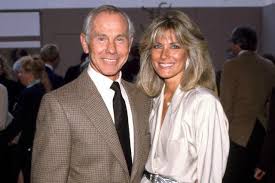
In the bright, noisy constellation of Hollywood fame, where every life is a story told in headlines, the story of Alexis Maas glows with a different, quieter light. She is known to the world almost exclusively through her relationship with Johnny Carson, the legendary “King of Late Night” television. For thirty years, Carson was America’s bedtime companion, a master of wit and timing who defined an era of entertainment. His personal life, however, was a series of public storms—three tumultuous divorces, battles with alcohol, and a fiercely guarded privacy. Into this complex world stepped Alexis Maas in 1987, not as another character in the drama, but as its calming conclusion. Their eighteen-year marriage, lasting until Carson’s death in 2005, is widely regarded as his most placid and enduring union. This is the story not just of a socialite or an heiress, but of a profoundly private woman whose steady presence provided the legendary performer with something he had long sought: a peaceful harbor. The narrative of Alexis Maas is one of deliberate silence, quiet strength, and a love that chose depth over spectacle, forever altering the final act of an American icon’s life.
The Formative Years of Alexis Maas: Building a Foundation of Privacy
Long before the name Johnny Carson entered her world, Alexis Maas was cultivating a life defined by normalcy and discretion. She was born Alexis Maas on July 15, 1952, in Pittsburgh, Pennsylvania, under the zodiac sign of Cancer. Unlike many who would later orbit Carson’s universe, her background was not in entertainment or public life. Details about her childhood and family remain closely guarded, a testament to the private nature she has maintained throughout her life. What emerges from the scant information is a portrait of a woman who grew up with a simple, calm lifestyle, removed from the glittering pressures of Hollywood. This early foundation in a world away from the spotlight would become the bedrock of her character, equipping her with an innate understanding of a life not measured by fame or public perception.
Prior to her marriage, Alexis Maas built a professional career for herself, working in the serious and demanding world of finance as a stockbroker. This role required analysis, discretion, and a steady temperament—qualities that would later define her approach to her personal life in the blinding glare of celebrity. She was successful in her own right, living independently and focusing on her work. Notably, she had never been married before meeting Carson. Her life was that of a capable, private professional woman, a reality far removed from the caricature of a socialite seeking fame. This period of self-sufficient normality was crucial. It meant that when she eventually entered Johnny Carson’s rarefied world, she did so not as someone seeking validation or a place in the sun, but as a fully formed individual with her own internal compass. Her identity was not something to be found in his reflection; it was already firmly established in the values of quiet competence and personal reserve.
The Malibu Meeting: A Chance Encounter That Changed Everything
The origin story of Johnny Carson and Alexis Maas reads like a scene from a classic, understated romance. The meeting occurred in the early 1980s in Malibu, California, a coastal enclave known for its beautiful beaches and celebrity residents. According to various accounts, their first encounter was both simple and fateful. Carson, then in his late fifties and navigating life after his third divorce, reportedly saw Alexis on the beach. Some versions suggest they met at a local Malibu spot like the Colony Coffee Shop, a favorite haunt for locals. Regardless of the precise location, the connection was immediate. Here was Johnny Carson, one of the most recognizable men in America, a figure who commanded stages and controlled national conversations with a wave of his hand. And there was Alexis Maas, a private woman from Pittsburgh with a career in finance, utterly unimpressed by the machinery of fame. In that difference lay the attraction.
Their relationship developed away from the cameras. They began dating in the mid-1980s, a period that allowed them to build a genuine connection without the immediate pressure of wedding plans. The age difference was notable—Carson was 61 when they married in 1987, and Alexis was 35. While the outside world might have speculated or gossiped about the gap, those close to the couple observed a fundamental shift in Carson. Friends and associates noted a new “lightness” in him after Alexis Maas entered his life. The man known for being intensely private and often remote in his personal relationships seemed to have found a sense of calm and companionship that had eluded him in his previous, more volatile marriages. This courtship period was the quiet prologue to a marriage that would defy the turbulent patterns of Carson’s past, suggesting that Alexis Maas offered not just romance, but a profound sense of peace.
A Private Union: The Wedding and Marriage to Johnny Carson
True to the characters of both individuals, the wedding of Johnny Carson and Alexis Maas was an exercise in understated intimacy. They were married on June 20, 1987, in a ceremony that perfectly encapsulated their shared desire for privacy. The wedding took place at Carson’s home in Malibu, with the vast Pacific Ocean as their backdrop. The guest list was minuscule. In attendance were only Carson’s brother, Dick Carson, and a few select close friends. In a poignant modern touch that emphasized family despite distance, Alexis’s parents, who were on the East Coast, listened to the proceedings over a speakerphone. There was no media circus, no exclusive photos sold to magazines, no celebrity guest list. A Superior Court Judge officiated, and the affair was quiet and simple, a stark contrast to the lavish, headline-making events typical of Hollywood royalty. This wasn’t a show for public consumption; it was a personal commitment, a deliberate choice to begin their life together within a bubble of their own making.
The marriage that followed was characterized by a contented seclusion. After Carson’s iconic retirement from The Tonight Show in 1992, the couple withdrew almost completely from public life. They split their time between luxurious yet private residences: a 16-bedroom mansion in Malibu and a 14,000-square-foot home in Beverly Hills. Their life together was built on shared interests that suited their reclusive lifestyle. They enjoyed world travel, with reports that Carson even took an interest in learning Swahili for trips to Africa. They spent time on their yacht, away from prying eyes. Alexis Maas, despite now having access to immense wealth and the highest echelons of society, never leveraged her position for public attention. She did not launch a clothing line, write a tell-all book, or become a fixture on the charity gala circuit. Her role was that of a partner and companion in the truest sense. Producer George Schlatter perhaps summed it up best when he stated in a 2005 interview, “The real love of [Johnny’s] life was Alex”. In a life filled with applause and artifice, the marriage to Alexis Maas represented something authentic and sustained—it was the longest and, by all accounts, the happiest of Carson’s four marriages.
Table: The Contrast in Carson’s Marriages
| Marriage | Spouse | Years | Public Characterization | Key Challenges |
|---|---|---|---|---|
| First | Jody Wolcott | 1949-1963 | Volatile, “boozy rows” | Infidelity, alcohol-fueled arguments |
| Second | Joanne Copeland | 1963-1972 | “Married to two different people” | Carson’s alcohol-induced anger and blackouts |
| Third | Joanna Holland | 1972-1985 | “Scary times” during “black drunk” phases | Alcoholism, culminating in a drunk driving arrest |
| Fourth | Alexis Maas | 1987-2005 | “The most placid,” marked by “lightness” | Carson’s retirement and health decline; managed privately. |
The Anchor in Stormy Seas: Contrast with Carson’s Past and His Health Decline
To fully appreciate the stabilizing force Alexis Maas represented, one must understand the turbulence that preceded her. Johnny Carson’s previous marriages were marred by significant strife, much of it connected to his well-documented struggle with alcohol. His first wife, Jody Wolcott, described relationships marked by “boozy rows aplenty” and volatile behavior. His second wife, Joanne Copeland, famously said she felt “married to two different people”—the charming Johnny and the angry, drunk “tiger” he could become. She recalled him coming home in the early hours, ripping sheets off the bed, and harboring a “tremendous anger about women”. His third wife, Joanna Holland, spoke of being scared during his “black drunk” phases. A 2024 biography, Carson the Magnificent, details how alcohol could turn him into a “red-hot demon” and an “unrecognizable hellion”. This was the wounded, complex man Alexis Maas chose to marry.
In stark contrast, their marriage is consistently described as Carson’s least fraught and most peaceful relationship. Biographers and friends suggest a key reason: “She let Johnny be Johnny”. There was no public power struggle, no attempt to change his essential reclusive nature. Furthermore, their marriage coincided with his retirement from The Tonight Show in 1992, removing the immense daily pressure that had fueled his anxieties for three decades. Alexis provided a calm center as Carson faced serious health challenges. A lifelong heavy smoker, he suffered a heart attack in 1999 and underwent quadruple bypass surgery. His final years were a battle with emphysema, a debilitating lung disease. Throughout this decline, Alexis Maas was his steadfast caregiver and companion, maintaining their privacy even as his health faded. She was the anchor in these stormy final years, providing not the drama of his past, but the dignified, quiet support he needed.
Life as a Custodian of Legacy: The Death of Carson and Its Aftermath
Johnny Carson died on January 23, 2005, at the age of 79 from complications related to emphysema. His passing was not just a personal loss for Alexis but the end of a television era, mourned by millions. For Alexis Maas, the intensely private wife, it meant transitioning from a partner to a custodian—of his estate, his legacy, and her own solitude. Carson’s net worth at the time of his death was estimated to be a staggering $300 million. While his will was private, it was widely reported that his estate was divided between his three sons from his first marriage and Alexis. She inherited a significant portion, ensuring her financial security for life. However, her actions following his death spoke volumes about her character and her respect for his legacy.
In a move that demonstrated remarkable generosity and foresight, Alexis Maas chose to donate a substantial portion of her inheritance—reported to be nearly $156 million—to the Johnny Carson Foundation. This philanthropic act ensured that Carson’s wealth would continue to support charitable causes, cementing his legacy in a positive, impactful way far beyond show business. It was a decision made without fanfare, consistent with her lifelong aversion to the spotlight. After settling affairs, she retreated completely from public view. She sold the couple’s iconic Malibu and Beverly Hills properties. Her only known public appearance in the years since was in the 2012 documentary Johnny Carson: King of Late Night, and even then, her participation was quiet and respectful. Reports suggest she may still live in California, but her exact whereabouts are unknown and fiercely protected. She has not remarried and has given no interviews. In the nearly two decades since Carson’s death, Alexis Maas has mastered the art of invisibility, choosing a life of peaceful anonymity over the lingering glow of reflected fame.
“The real love of [Johnny’s] life was Alex.” – Producer George Schlatter, in a 2005 interview with People magazine, summarizing the profound and transformative bond between Johnny Carson and Alexis Maas.
The Enduring Enigma: Alexis Maas in the Modern Context
In today’s world of oversharing, constant social media updates, and celebrity branding, the sustained silence of Alexis Maas is not just rare; it is revolutionary. In an era where the widow of a cultural icon might be expected to become a brand ambassador, a reality star, or a prolific memoirist, she has chosen none of these paths. As of 2025, she is 73 years old, and her life remains a closed book. This deliberate obscurity has, ironically, only fueled public curiosity. Searches for her name persist, not because she creates new content, but precisely because she does not. She represents a fascinating paradox: a figure who is known only because of her association with fame, yet who has rejected every tenet of a fame-based existence. Her story resonates because it is a powerful testament to the idea that some values—privacy, dignity, authentic love—can still be held above public consumption.
The legacy of Alexis Maas, therefore, is a dual one. First, she is an integral part of Johnny Carson’s story. Historians and biographers acknowledge that his final chapter, though shadowed by illness, was his most personally settled, and she is the central reason for that. She provided the quiet love and stable home that the “King of Late Night” needed to find peace off-screen. Second, and perhaps more compellingly, she has crafted a legacy entirely of her own making: one of intentional silence. In a culture that often mistakes visibility for value, Alexis Maas stands as a quiet counterpoint. She teaches that the most powerful narrative can be the one you refuse to narrate, that the strongest statement can be a respectful silence, and that a life lived truly for oneself and one’s loved ones, away from the public gaze, is not a life wasted but a life deeply understood. Her enduring mystery is not a void, but a profound choice—a final, quiet lesson from the woman who helped settle the storm around Johnny Carson.
Conclusion
The journey of Alexis Maas from a Pittsburgh childhood and a career in finance to becoming the final, grounding love of Johnny Carson’s life is a narrative that gains its power from subtraction, not addition. It is a story defined by what was not done: not seeking the spotlight, not engaging in public drama, not capitalizing on fame, and not breaking a steadfast vow of privacy even after becoming one of the most famous widows in America. Her relationship with Carson proved that for a man who had everything the public could offer—acclaim, wealth, influence—what he needed most was something only a private world could provide: genuine peace. Alexis Maas was the architect of that peace. Through her steady presence, she helped usher the mercurial comedy legend into a gentler, more reflective retirement, standing by him with quiet strength through his final health battles. In the aftermath of his death, her actions—the generous philanthropy, the dignified retreat—reflected a deep understanding of legacy and a profound commitment to her own values. Today, she remains an enigma by choice, a figure who mastered the art of disappearing in plain sight. The story of Alexis Maas ultimately reminds us that in the loud, curated theater of modern life, there is immense dignity and strength in a quiet narrative, and that the most lasting love stories are sometimes the ones whispered, not shouted.
Frequently Asked Questions About Alexis Maas
What was Alexis Maas’s life like before she met Johnny Carson?
Before her life became intertwined with Johnny Carson’s world of late-night fame, Alexis Maas lived a notably private and independent life. She was born and raised in Pittsburgh, Pennsylvania, and pursued a career as a stockbroker, a profession that required analytical skill and discretion. This period was marked by normalcy and self-sufficiency, with no indication she sought or moved in celebrity circles. Her life before fame was characterized by a quiet, calm lifestyle that stood in stark contrast to the Hollywood milieu she would later enter through her marriage.
How did Alexis Maas and Johnny Carson meet?
Alexis Maas and Johnny Carson met in the early 1980s in Malibu, California. The most common account is that they had a chance encounter on a Malibu beach, where Carson first saw her. Other reports suggest they may have crossed paths at a local spot like the Colony Coffee Shop, a gathering place for Malibu residents. Their connection was immediate, and they began a courtship that lasted several years before marrying in 1987. This meeting between the immensely famous talk show host and the private stockbroker from Pittsburgh sparked what would become the most stable and enduring relationship of Carson’s life.
Why is the marriage of Alexis Maas and Johnny Carson considered so different from his previous ones?
The marriage between Alexis Maas and Johnny Carson is consistently described as his most placid and successful, primarily because it lacked the volatility that marked his previous unions. Carson’s earlier marriages were fraught with conflict, infidelity, and severe struggles with alcohol, which often triggered angry and sometimes violent behavior. In contrast, his relationship with Alexis Maas was peaceful. Friends observed a “lightness” in him after they got together. She reportedly “let Johnny be Johnny,” accepting his need for privacy without conflict. Furthermore, their marriage coincided with his retirement from The Tonight Show, removing a major source of professional pressure and allowing for a quieter, more reflective life together.
What happened to Alexis Maas after Johnny Carson died?
Following Johnny Carson’s death in 2005, Alexis Maas executed a near-total retreat from public life. She handled his estate with notable generosity, donating a reported $156 million of her inheritance to the Johnny Carson Foundation to support his charitable legacy. She sold their lavish homes in Malibu and Beverly Hills and has since lived in complete anonymity. Her only known public appearance was a brief, respectful participation in a 2012 documentary about Carson. She has not remarried, given no interviews, and maintains no public profile. Alexis Maas chose to honor her and her husband’s shared value of privacy by living out her years away from any media attention.
What is the net worth of Alexis Maas?
While exact figures are private, Alexis Maas inherited a significant portion of Johnny Carson’s estate, which was valued at approximately $300 million at the time of his death in 2005. Her financial situation was secured through this inheritance. However, her net worth is likely less than the total she inherited due to her substantial philanthropic gift of nearly $156 million to the Johnny Carson Foundation. This act significantly reduced her personal wealth but ensured the money would fund charitable causes. Today, it is believed that Alexis Maas lives a comfortable and financially secure life, though she does so with the same discretion that has defined her entire public persona.