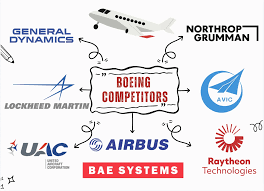
The name Boeing is synonymous with aerospace. For over a century, the company has been a pillar of American industry, shaping global aviation with iconic aircraft like the 747 Jumbo Jet and the workhorse 737. Its reach extends from commercial airliners thronging international airports to advanced fighter jets, satellites, and spacecraft. Yet, the skies and the stars are not its alone. The arena in which Boeing operates is one of the most capital-intensive, technologically demanding, and strategically vital in the world, and it is populated by a diverse array of formidable Boeing competitors. These rivals challenge the company on every front—in the bustling commercial market, the high-stakes defense sector, and the new frontier of space. Understanding these Boeing competitors is not just about understanding one company’s challenges; it’s about mapping the forces that drive innovation, dictate global travel, and secure national sovereignties. This landscape is a dynamic chessboard where decades-old European conglomerates, ambitious new-space disruptors, and rising global powers all vie for dominance, ensuring that Boeing can never rest on its laurels.
The competitive pressure on Boeing is multifaceted. It’s not merely about selling more planes or winning a single contract; it’s a continuous battle for engineering talent, supply chain dominance, technological supremacy, and the confidence of airlines, governments, and the traveling public. Recent challenges for Boeing, including the tragedies and controversies surrounding the 737 MAX and program delays like the Starliner spacecraft, have exposed vulnerabilities that its Boeing competitors are keen to exploit. This article will embark on a comprehensive journey through this competitive ecosystem. We will dissect the commercial duopoly, explore the complex web of defense and security rivals, probe the new space race, and examine the emerging players from Asia and elsewhere. By the end, you will have a clear picture of who Boeing is up against and how these rivalries are forging the future of flight.
The Commercial Aviation Duopoly: Airbus vs. Boeing
When discussing Boeing competitors in commercial aviation, one name towers above all others: Airbus. This is not just a rivalry; it is a duopoly that has defined the industry for over five decades. The two companies split the vast majority of the market for large commercial jetliners, with their competition influencing airline fleets, route structures, and ticket prices worldwide. The Airbus-Boeing dynamic is a classic transatlantic contest, pitting European industrial collaboration against American aerospace tradition. For airlines, this duopoly provides choice and negotiation leverage, but it also means the strategic plans of these two giants directly shape the future of air travel.
The competition is product-line to product-line. Boeing’s 737 MAX family, despite its troubles, is the direct counter to Airbus’s wildly successful A320neo family. In the widebody segment, Boeing’s 787 Dreamliner, with its revolutionary composite construction, battles the Airbus A350. The now-out-of-production Boeing 747 and 777 have long competed with the Airbus A380 (also out of production) and A330/A340 families. Every decision by one manufacturer forces a reaction from the other. When Airbus launched the A320neo with its fuel-efficient engines, Boeing was compelled to respond with the 737 MAX. This tit-for-tat development drives technological leaps but also carries immense financial risk, as developing a new aircraft program can cost upwards of $20 billion. The health of this duopoly is currently asymmetrical. Airbus has consistently outpaced Boeing in orders and deliveries in recent years, capitalizing on the grounding of the 737 MAX and subsequent production issues at Boeing. This has allowed Airbus to build a significant backlog, solidifying its position as the world’s largest planemaker—a title Boeing held for most of the rivalry.
“The competition between Airbus and Boeing is the greatest show in business—a high-stakes, long-term poker game where the ante is billions of dollars and the prize is the future of global mobility.” – Industry Analyst, Aviation Week.
Beyond the head-to-head model competition, the rivalry extends into manufacturing philosophy, supply chain control, and customer support. Airbus pioneered the use of globally distributed manufacturing, with major components built across Europe and assembled in Toulouse, France, or Hamburg, Germany. Boeing, while also global, has traditionally had a more centralized final assembly in Washington state and South Carolina. Both are now grappling with similar supply chain challenges post-pandemic. Furthermore, the battle for aftermarket services—providing spare parts, maintenance, and training—is a crucial and highly profitable front in this war. Winning an aircraft order is just the beginning; locking in an airline as a service customer for decades is the ultimate goal, and both companies deploy vast resources to achieve it. As we look ahead, this duopoly faces pressure not from each other, but from potential disruptors in new market segments, such as the emerging field of sustainable aviation and regional travel, where other Boeing competitors are beginning to stir.
The Defense and Security Arena: A Global Battlefield
While the commercial duopoly captures headlines, Boeing’s defense, space, and security division is a colossal enterprise in its own right, and here the list of Boeing competitors is longer and more varied. In the defense sector, Boeing is a prime contractor for some of the most sophisticated and expensive weapons systems in the world, including fighter jets like the F-15EX and F/A-18 Super Hornet, military aircraft like the KC-46 tanker and P-8 Poseidon, helicopters like the AH-64 Apache and CH-47 Chinook, and missile defense systems. In this realm, its primary adversaries are other American giants and a select group of international consortia. The competition is fierce, as defense contracts are often measured in tens of billions of dollars and are deeply intertwined with national security strategy and geopolitical alliances.
The most significant domestic rival is Lockheed Martin. It is the world’s largest defense contractor by revenue, and its dominance in the fighter jet arena with the F-35 Lightning II represents a major competitive threat to Boeing’s legacy fighter programs. While Boeing’s F-15EX is a modernized version of a proven platform, the F-35 is a newer, stealthy, multi-role aircraft purchased by the U.S. and numerous allies. Lockheed also competes in space, satellites, and missile systems. Northrop Grumman is another formidable Boeing competitor, excelling in areas like strategic bombers (the B-2 Spirit and the new B-21 Raider), autonomous systems, and cybersecurity—sectors where Boeing also has strong interests. The battle for the next-generation technologies—hypersonics, directed energy, autonomous loyal wingman drones, and space-based systems—is where these companies are investing billions in research and development to outmaneuver each other.
Internationally, the defense landscape includes powerful Boeing competitors like France’s Dassault Aviation (maker of the Rafale fighter), the European multinational Airbus Defence and Space (producer of the A400M transport and Eurofighter Typhoon), and Britain’s BAE Systems. These companies often benefit from “home nation” preference within their domestic markets and allied countries, making it difficult for Boeing to break in. For instance, in many European and Middle Eastern fighter jet competitions, Boeing’s F/A-18 or F-15 face stiff political and industrial pressure in favor of the Eurofighter or Rafale. Furthermore, the rise of other global players, such as Russia’s Rostec (marketing the Su-35 fighter) and a rapidly modernizing Chinese defense industry, creates a more complex global market. While Boeing does not directly compete with Chinese firms in the U.S. market, these companies challenge Boeing’s international sales and influence U.S. strategic calculations, indirectly shaping the competitive environment in which Boeing’s defense division must operate.
| Defense Sector | Key Boeing Product | Primary Competitor(s) | Competitor’s Product |
|---|---|---|---|
| Fighter Jets | F-15EX, F/A-18 Super Hornet | Lockheed Martin, Dassault, Eurofighter consortium | F-35 Lightning II, Dassault Rafale, Eurofighter Typhoon |
| Military Transport/Tanker | KC-46 Pegasus, C-17 Globemaster III | Airbus Defence and Space, Lockheed Martin | A330 MRTT, A400M, C-130J Super Hercules |
| Military Helicopters | AH-64 Apache, CH-47 Chinook | Bell Textron (Lockheed-owned Sikorsky), Russian Helicopters) | Bell V-280, UH-60 Black Hawk, Mi-17 |
| Missiles & Strike | Harpoon, JDAM | Raytheon, Lockheed Martin | Javelin, Hellfire, LRASM |
The New Space Race: Disruptors and Legacy Rivals
Space is no longer the exclusive domain of government agencies and a handful of monolithic contractors like Boeing. The 21st century has witnessed the explosive rise of “New Space” companies, fundamentally altering the competitive dynamics. In this high frontier, Boeing finds itself in a paradoxical position: it is both an entrenched incumbent with historic achievements (like building the core stages of the Saturn V rocket and the International Space Station modules) and a company struggling to keep pace with the agility and ambition of its new Boeing competitors. The competition spans launch services, spacecraft, satellite technology, and the burgeoning vision of a space economy.
The most prominent and disruptive of these new Boeing competitors is SpaceX. Founded by Elon Musk, SpaceX has upended the launch industry with its reusable Falcon 9 and Falcon Heavy rockets, dramatically reducing the cost of access to space. Boeing, through its joint venture United Launch Alliance (ULA) with Lockheed Martin, long held a monopoly on U.S. national security launches with its Atlas V and Delta IV rockets. SpaceX’s Falcon 9, certified for national security missions, has broken that monopoly, winning a significant share of launch contracts. Even more critically, in NASA’s Commercial Crew Program, SpaceX’s Crew Dragon spacecraft has been ferrying astronauts to the ISS for years, while Boeing’s Starliner has faced significant technical delays and cost overruns. This has been a stark and public contrast in execution. Furthermore, SpaceX’s development of the colossal Starship vehicle, aimed at lunar and Mars missions, presents a long-term challenge to Boeing’s role in NASA’s Artemis program, where Boeing is building the Space Launch System (SLS) core stage—a powerful but extremely expensive and expendable rocket.
But the list of Boeing competitors in space extends beyond SpaceX. Jeff Bezos’s Blue Origin is developing the New Glenn heavy-lift rocket and is a key partner on the Artemis program’s Human Landing System, competing for future lunar contracts. In satellite manufacturing, a traditional Boeing strength, companies like Maxar Technologies and Airbus Defence and Space are strong competitors. Perhaps most intriguingly, a host of smaller startups are innovating in areas like small-satellite launch (Rocket Lab, Relativity Space), in-space propulsion, and space habitats. Boeing’s challenge is cultural and operational as much as technological. Can a century-old corporate giant, with its legacy processes and cost structures, innovate at the speed and risk-appetite of these newer, privately-funded rivals? The company’s future in space—a domain it helped pioneer—depends on answering this question affirmatively, adapting its vast engineering talent to a new, faster-paced competitive reality.
The Rise of COMAC and Other Regional Jet Challengers
For decades, the commercial jetliner market above 100 seats was almost exclusively the domain of Boeing and Airbus. That absolute duopoly is now facing its most credible long-term threat from a new player: the Commercial Aircraft Corporation of China (COMAC). Backed by the full financial and political might of the Chinese state, COMAC is not just another manufacturer; it is a strategic national project aimed at breaking the Western hold on a critical technology sector. Its first major airliner, the narrowbody C919, is a direct competitor to the Boeing 737 MAX and Airbus A320neo families. While it currently relies on Western engines (from CFM International) and avionics, its design, integration, and production are Chinese, and the long-term goal is indigenization. For Boeing, COMAC represents a unique competitive threat that is as much geopolitical as it is commercial.Boeing Competitors
COMAC’s primary market advantage is its captive domestic audience. China is projected to be the world’s largest aviation market within the next decade. The Chinese government can, and does, direct its state-owned airlines to purchase COMAC aircraft, guaranteeing a substantial production backlog and providing a protected environment for the manufacturer to mature its product, gain operational experience, and work out early-stage issues—a luxury neither Boeing nor Airbus had in their infancy. Once the C919 is proven domestically, COMAC will look to export, initially to nations within China’s geopolitical sphere of influence and in developing markets where price and political ties may outweigh brand loyalty. The newer widebody program, the C929 (in partnership with Russia’s United Aircraft Corporation), aims to eventually challenge the Boeing 787 and Airbus A350. While technical and certification hurdles remain significant, dismissing COMAC would be a grave mistake for Boeing. It is a Boeing competitor with near-unlimited patience and resources, playing a century-long game.
Beyond COMAC, the regional jet market features other important, though smaller-scale, Boeing competitors. Brazil’s Embraer, while now effectively out of the larger narrowbody race after its failed partnership with Boeing, remains a dominant force in the regional jet (70-150 seat) market with its E-Jet E2 series. These aircraft compete with the smallest models of the A320 and 737 families. In the smaller turboprop segment, France’s ATR (a joint venture between Airbus and Leonardo) holds a commanding position. While these companies do not challenge Boeing across its full product spectrum, they compete fiercely at the lower end of the capacity scale, influencing the strategies of regional airlines that may be feeders for larger Boeing operators. Furthermore, Japan’s Mitsubishi Heavy Industries made a costly and ultimately suspended attempt to enter the market with the SpaceJet, highlighting the immense barriers to entry but also the global desire to compete in this lucrative sector. The rise of these players ensures the commercial aerospace market will become more multipolar over the coming decades.
The Supplier as Competitor: A Complex Dynamic
In the intricate ecosystem of aerospace manufacturing, the line between partner and competitor can be remarkably thin. Boeing, like Airbus, relies on a vast global network of thousands of suppliers for everything from bolts and fasteners to complete fuselage sections and advanced avionics systems. Some of these suppliers are so large and technologically capable that they have the potential to become Boeing competitors in their own right, either by integrating vertically or by using their leverage to capture more value from the production chain. This creates a complex, sometimes cooperative, sometimes adversarial relationship that Boeing must manage carefully.
The most prominent example is perhaps Spirit AeroSystems. Originally a division of Boeing itself, Spirit was spun off in 2005 to become an independent supplier. It is a critical partner, building the entire forward fuselage and other major structures for the 737 MAX. However, Spirit also works for Airbus and other manufacturers, spreading its expertise and risk. Boeing’s deep dependence on Spirit was starkly revealed during the 737 MAX grounding and the subsequent production halt, where financial and production issues at Spirit directly impacted Boeing’s ability to deliver aircraft. This interdependence gives a major supplier significant leverage. Similarly, engine manufacturers like GE Aerospace (through the CFM International joint venture with Safran), Pratt & Whitney, and Rolls-Royce are colossal entities. An airline’s choice of aircraft is often dictated by its engine preference and the associated maintenance contracts. These engine makers wield enormous influence; they are not merely component suppliers but key stakeholders in the success of an aircraft program. Their technological roadmaps for fuel efficiency and sustainability can make or break a new airliner.Boeing Competitors
Furthermore, companies that specialize in advanced subsystems—such as Raytheon Technologies in avionics and Collins Aerospace in interiors and systems—possess deep expertise that Boeing needs. However, these companies also sell their products and services directly to airlines for upgrades and retrofits, competing with Boeing’s own aftermarket services division. In the defense sector, the dynamic is even more complex, as major subcontractors on one program (like Northrop Grumman building the center fuselage for the B-21) can be the prime competitor on another (like for the next-generation fighter). For Boeing, managing these relationships requires a delicate balance: fostering collaboration and innovation with suppliers while protecting its own intellectual property, profit margins, and strategic control over integration—the core competency that justifies its role as the prime contractor. The threat of supplier vertical integration or alliance with a direct competitor is a constant undercurrent in its strategic planning.Boeing Competitors
Technological Frontiers: Sustainability, Autonomy, and Hypersonics
The future of aerospace will be won not just by selling today’s aircraft but by mastering tomorrow’s technologies. The most intense competition between Boeing and its rivals is increasingly focused on several cutting-edge frontiers that promise to redefine flight. Leadership in these areas is critical for long-term survival and dominance. Sustainability, particularly the development of sustainable aviation fuel (SAF) compatibility and next-generation hydrogen-electric or battery-electric propulsion, is arguably the most pressing. Airlines and governments are setting aggressive decarbonization targets, and the manufacturer that can deliver a genuinely low-emission aircraft will capture a commanding market position. Here, Airbus has publicly committed to launching the world’s first hydrogen-powered commercial aircraft by 2035, investing heavily in its ZEROe program. Boeing is also researching hydrogen, advanced aerodynamic designs, and SAF, but the perception, whether fair or not, is that Airbus is currently setting the public agenda. Both face potential disruption from startups like Heart Aerospace or Eviation, which are targeting the regional market with all-electric aircraft.
Autonomy and advanced air mobility (AAM) represent another battleground. While Boeing and Airbus are investing in autonomous flight technology for both cargo and eventually passenger aircraft, they face a swarm of well-funded startups like Joby Aviation, Archer Aviation, and Beta Technologies developing electric vertical take-off and landing (eVTOL) “air taxis.” These companies aim to create a new market for urban and regional travel, potentially siphoning off short-haul traffic from traditional airlines. Boeing, through its ventures like Wisk Aero (an eVTOL developer), and partnerships, is attempting to play in this space, but it is far from a guaranteed leader. Similarly, in the realm of hypersonic flight (Mach 5+), the competition is largely within the defense sector, with companies like Lockheed Martin’s Skunk Works, Northrop Grumman, and Raytheon all vying for lucrative research and development contracts from DARPA and the U.S. Air Force. Boeing’s own hypersonic projects, like the now-canceled X-20 Dyna-Soar heritage and current concepts, place it in a fierce technological race where the winners will define the future of rapid global strike and reconnaissance.Boeing Competitors
The digital thread—the use of advanced simulation, artificial intelligence, digital twins, and robotics in design, manufacturing, and maintenance—is a less visible but equally critical arena of competition. All major aerospace firms are racing to digitize their operations to improve efficiency, reduce errors, and predict maintenance needs. Here, Boeing faces competition not only from its traditional rivals but also from large tech companies like Siemens, Dassault Systèmes, and even cloud providers like Amazon Web Services and Microsoft Azure, which provide the underlying platforms. The ability to harness data across an aircraft’s entire lifecycle, from drawing board to retirement, will be a key differentiator in cost, reliability, and customer satisfaction. In all these technological frontiers, Boeing’s vast R&D budget and engineering heritage are assets, but they must be deployed with speed and focus to outpace both agile startups and deep-pocketed legacy Boeing competitors.
Geopolitical Winds and Trade Disputes
The competition between Boeing and its rivals does not occur in a vacuum; it is profoundly shaped by the winds of geopolitics and international trade. Government intervention—through subsidies, tariffs, trade disputes, and diplomatic pressure—is a constant feature of the landscape, often tilting the playing field. The most long-standing and consequential conflict is the transatlantic trade dispute between the United States and the European Union over aircraft subsidies. For nearly two decades, the U.S. has argued that Airbus benefited from “launch aid” loans from European governments that were effectively illegal subsidies, while the EU has countered that Boeing received billions in unfair support through NASA and Department of Defense research contracts and tax breaks from Washington state. This dispute has led to a series of rulings at the World Trade Organization (WTO) and the imposition of punitive tariffs on unrelated goods, from wine to tractors, hurting businesses on both sides.Boeing Competitors
For Boeing, this dispute is a double-edged sword. On one hand, it provides a legal and political framework to challenge the practices of its biggest competitor, Airbus. On the other hand, it creates uncertainty for airlines, which may face higher costs or limited choices due to tariffs, and it complicates global supply chains. While a truce was negotiated in 2021, tensions can easily re-escalate, showing how closely the fortunes of these companies are tied to government relations. Beyond Airbus, geopolitics affects competition with other Boeing competitors. Sales of Boeing defense equipment are frequently instruments of U.S. foreign policy, with deals approved or blocked based on strategic relationships. Conversely, sales by competitors like Russia’s Rosoboronexport or France’s Dassault can be driven by similar geopolitical calculations. The rise of COMAC is inextricably linked to U.S.-China strategic competition. Technology transfer restrictions and security concerns make it unlikely that COMAC aircraft will be certified or sold in the U.S. anytime soon, but they will compete fiercely with Boeing in third-party markets where China exerts economic and political influence, such as Africa, Southeast Asia, and Latin America.
Furthermore, “offset” agreements are a standard part of major international aerospace sales. To win a contract from a foreign government, a company like Boeing is often required to invest in local industries, share technology, or establish joint ventures. This practice, while securing a sale, can inadvertently foster the development of future Boeing competitors by transferring knowledge and capability. Navigating this geopolitical maze requires Boeing to maintain a world-class government affairs operation, aligning its commercial interests with the strategic objectives of the United States while mitigating the risks posed by the industrial policies of other nations. It is a high-level game where diplomatic skill is as important as engineering excellence.
The Future of Flight: Collaboration and Co-opetition
Given the astronomical costs and risks associated with developing new aircraft and technologies, even the fiercest of rivals are sometimes forced to collaborate. This concept, known as “co-opetition”—competing in some areas while cooperating in others—is a hallmark of the aerospace industry. For Boeing, this means that some of its Boeing competitors are also, at times, its partners. These alliances are formed to share financial burden, pool technical expertise, gain market access, or meet specific customer demands. Understanding these cooperative ventures is essential to grasping the full complexity of the competitive landscape.
One of the most significant examples is the joint venture with Lockheed Martin, United Launch Alliance (ULA). Formed in 2006, it combined the government launch businesses of both companies to service the U.S. military and NASA. For years, it was a dominant, monopoly-like provider, but it was a partnership between two defense titans who compete viciously in other sectors like fighter jets and missile systems. Similarly, in the commercial realm, Boeing and Japanese industrial giants like Mitsubishi Heavy Industries, Kawasaki, and Subaru have deep, decades-long partnerships where the Japanese companies manufacture major sections of Boeing airframes (like the 787 wings). Yet, Mitsubishi was also developing its own SpaceJet regional airliner, a potential competitor. The relationship with Embraer was poised to be a major cooperative move, with Boeing planning to take an 80% stake in Embraer’s commercial division to better compete with Airbus’s takeover of the CSeries (now A220). When Boeing walked away from the deal in 2020, it turned a potential partner into a disgruntled and reinvigorated competitor.
Looking forward, the challenges of sustainability and the space economy may drive even more unconventional partnerships. The development of hydrogen infrastructure at airports, for example, will require coordination between aircraft manufacturers, engine makers, energy companies, and governments—a consortium that will likely include multiple Boeing competitors. In space, Boeing is a key contractor on NASA’s Artemis program, which also involves contributions from Northrop Grumman, Lockheed Martin, SpaceX, and Blue Origin. They are all simultaneously partners in a national endeavor and competitors for follow-on contracts and commercial spin-offs. For Boeing, mastering co-opetition is a strategic imperative. It must protect its core proprietary technologies while engaging in pre-competitive research, standard-setting bodies, and industry consortia where collaboration is necessary to advance the entire ecosystem. The ability to simultaneously compete and collaborate with the same entities is a defining feature of being a modern aerospace giant.
Conclusion: An Unending Contest for the Skies
The panorama of Boeing competitors reveals an industry in constant, vigorous flux. Boeing is not engaged in a single battle but a multi-front war for supremacy across commercial aviation, defense contracting, and space exploration. Its adversaries range from its historic arch-rival Airbus, with which it shares an intimate and all-consuming duopoly, to defense behemoths like Lockheed Martin and Northrop Grumman, to disruptive forces like SpaceX that have rewritten the rules of the game, to the state-backed long-term threat of COMAC. This competition is the engine of progress in aerospace, driving innovations in fuel efficiency, safety, capability, and cost. It is also a relentless pressure cooker, where missteps in design, manufacturing, or program management are swiftly and ruthlessly exploited.
Boeing’s future hinges on its ability to respond to this multifaceted challenge. It must stabilize and restore trust in its core commercial business, out-innovate its defense rivals for next-generation contracts, and find a way to match the speed and cost-effectiveness of the New Space players. It must do all this while managing a global supply chain, navigating geopolitical storms, and investing in the sustainable technologies that will define the next century of flight. The presence of so many formidable Boeing competitors ensures that the company cannot afford complacency. For the aviation and aerospace community—airlines, passengers, investors, and enthusiasts—this intense rivalry is ultimately beneficial. It promises a future with more advanced, efficient, and diverse options for travel and exploration. The contest for the skies, it seems, will continue to push humanity higher, faster, and farther, with Boeing and its competitors all vying to lead the way.
Frequently Asked Questions
Who is Boeing’s biggest competitor?
Boeing’s biggest competitor varies by sector. In commercial aviation, its primary and most significant competitor is Airbus, with whom it shares a global duopoly for large passenger jets. In the defense and military sector, its biggest competitors are other American giants, primarily Lockheed Martin, the world’s largest defense contractor, and Northrop Grumman. In the space sector, its most disruptive competitor is SpaceX. So, while Airbus is often named as the chief rival overall, the answer is nuanced and depends on the specific business unit and product line.
How does Boeing compete with Airbus?
Boeing competes with Airbus through direct product offerings (e.g., 737 MAX vs. A320neo, 787 vs. A350), continuous technological innovation (e.g., advanced composites, aerodynamic improvements), aggressive sales campaigns and financing options for airlines, and a global customer support network. The competition is also deeply political and legal, involving decades-long trade disputes over government subsidies at the World Trade Organization. Both companies constantly monitor each other’s product development and sales, often making strategic decisions specifically to counter the other’s moves.
Are there any new competitors for Boeing in commercial airplanes?
Yes, the most significant new competitor is China’s COMAC (Commercial Aircraft Corporation of China). Its C919 narrowbody airliner is designed to compete directly with the Boeing 737 MAX and Airbus A320neo. While currently focused on the massive Chinese domestic market, it poses a long-term strategic threat to the Boeing-Airbus duopoly, especially in regions influenced by Chinese diplomacy and financing. Other competitors exist in smaller market segments, like Embraer in regional jets, but COMAC represents the first credible challenger in the mainline jet market in decades.
What makes SpaceX such a strong competitor to Boeing in space?
SpaceX is a formidable Boeing competitor due to its radically different approach. It prioritizes reusable rocket technology (Falcon 9, Starship), which drastically lowers launch costs. It operates with a faster, more agile, and risk-tolerant development culture compared to traditional aerospace contractors. This has allowed it to capture a dominant share of the commercial launch market, break Boeing-Lockheed’s monopoly on U.S. national security launches through ULA, and beat Boeing’s Starliner in delivering astronauts to the International Space Station via NASA’s Commercial Crew Program. Its vertically integrated manufacturing also gives it greater cost and schedule control.
How do geopolitical factors influence Boeing’s competition?
Geopolitics profoundly influence Boeing’s competitive landscape. Trade disputes, like the long-running EU-U.S. conflict over aircraft subsidies, directly impact the cost and market access for Boeing versus Airbus. Sales of Boeing defense products are heavily influenced by U.S. foreign policy and alliances. Conversely, competitors like Russia’s Rostec or France’s Dassault benefit from their own government’s political support. The rise of COMAC is itself a geopolitical phenomenon, backed by China’s national industrial policy. Export controls, sanctions, and “offset” requirements for international sales all shape the competitive battlefield, often making government relations as important as product performance.