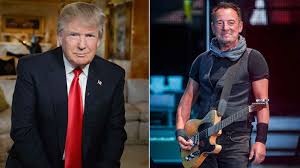
The stage lights blaze, casting long shadows from a solitary figure clutching a Fender guitar. The opening chords of “Born in the U.S.A.” ring out, a raw, muscular riff that vibrates deep in the chest of every person in the arena. For decades, Bruce Springsteen has stood as a secular saint of American rock and roll, his voice a gravelly testament to the struggles, dreams, and resilient spirit of the working class. His anthems are woven into the nation’s fabric, soundtracks for factory shifts, highway journeys, and quiet moments of hope. Yet, in the polarized climate of 21st-century America, this very iconography has been thrust into the center of a fierce political maelstrom, personified by one figure: Donald Trump. The relationship—or more accurately, the profound ideological collision—between Bruce Springsteen Trump represents more than a simple celebrity feud. It is a fundamental clash over narrative, over who owns the symbols of American identity, over the very meaning of the heartland Springsteen has mythologized for fifty years. This is not a story of two men who occasionally disagree; it is a compelling, often uncomfortable examination of how art is interpreted, co-opted, and weaponized in the battle for the nation’s soul.
Springsteen’s music chronicles the lives of the wired, the tired, the marginalized, and the forgotten—the very demographic that political analysts would later term the “left behind.” His songs are full of Vietnam veterans betrayed by their country, factory workers watching plants shutter, and young lovers seeking redemption on dusty backroads. He sings with empathy, anger, and a unwavering belief in collective dignity. Conversely, Donald Trump’s political rise was built on a powerful, populist narrative of American decline, channeling the economic anxiety and cultural resentment of a similar constituency. He promised restoration, strength, and a return to a mythologized past greatness. The explosive tension lies in this paradoxical overlap: two forces speaking to similar pains but offering diametrically opposed visions of the cure. Bruce Springsteen Trump is, therefore, a shorthand for a cultural civil war. It’s about how Trump and his movement have sought to claim Springsteen’s aesthetic terrain—the hardhat, the flag, the gritty determination—while Springsteen himself has become one of the most vocal and philosophically opposed celebrities to the 45th president. This article delves into the roots of this clash, exploring Springsteen’s artistic ethos, Trump’s populist appeal, the infamous misuse of Springsteen’s music at rallies, and the deeper battle over what it means to be American.
The Poet of the Working Class: Springsteen’s American Vision
To understand the depth of the Bruce Springsteen Trump divide, one must first journey into the heart of Springsteen’s artistic project. From the boardwalks of Asbury Park to the rusting factories of “The River,” Springsteen’s America is one of profound complexity. It is a land of breathtaking beauty and crushing inequality, of communal bonds and isolating despair. He is not a protest singer in the traditional, didactic sense; he is a storyteller. His characters are not symbols but fully realized people: Bad Scooter searching for something on the streets, the ghost of Tom Joad seeking justice, the worker in “Johnny 99” facing the ruin of deindustrialization. His anthems are often mistaken for blind patriotism. “Born in the U.S.A.” is the prime example—a searing indictment of a nation’s treatment of its Vietnam veterans, frequently misinterpreted as a chest-thumping nationalistic chant. This inherent tension between surface-level sound and lyrical substance is central to the Bruce Springsteen Trump dynamic.
Springsteen’s political philosophy, articulated in his music long before he ever publicly endorsed a candidate, is one of inclusive community, social justice, and economic fairness. His is a liberalism rooted in Catholic iconography and a deep sense of moral obligation. He champions the immigrant (“American Land”), laments the loss of industrial heartlands (“Youngstown”), and consistently sides with the underdog. His famous monologues during concerts are sermons on empathy, urging his audience to see the humanity in everyone. This vision is fundamentally at odds with a political framework built on division, “America First” isolationism, and a narrative of zero-sum competition. For Springsteen, the American promise is a collective endeavor to be extended; for Trump, as Springsteen sees it, it is a privilege to be guarded. The bedrock of the Bruce Springsteen Trump conflict is this irreconcilable difference in worldview: one based on expansive, empathetic solidarity, the other on nationalist, transactional allegiance.
The Populist Disrupter: Trump’s Claim on the Heartland
Donald Trump’s political ascendancy rewrote the rules of American engagement. A billionaire from Manhattan’s golden towers became the unlikely voice of millions in the Midwest and rural America. His rhetoric tapped into a deep well of legitimate grievance—globalization’s wounds, the opioid crisis, a sense of cultural and political disrespect from coastal elites. He spoke in the blunt, visceral language of grievance and restoration, promising to bring back jobs, renegotiate trade deals, and return a sense of proud, unapologetic American dominance. In doing so, he crafted a potent populist narrative that sought to claim the iconography of the American working class. The hardhat, the flag, the rhetoric of “real Americans”—these became central to Trump’s brand.
This is where the Bruce Springsteen Trump narrative intersects in a deeply ironic way. Trump’s campaign effectively channeled the feeling of many Springsteen songs—the anger, the betrayal, the yearning for recognition—but directed that energy toward a philosophy Springsteen’s art explicitly rejects. Trump’s populism was often exclusionary, framing the struggle as “us versus them,” where “them” could be immigrants, foreign nations, or political opponents. Springsteen’s storytelling, while unflinchingly honest about struggle, ultimately points toward a more inclusive “us.” The tragedy, from Springsteen’s perspective, is that the economic and social decay he documented for decades created the conditions for Trump’s rise, yet the solutions offered were anathema to his life’s work. The Bruce Springsteen Trump dichotomy thus represents two competing answers to the same painful question: how does a nation heal its wounded heartland?
The Soundtrack Wars: “Born in the U.S.A.” at Political Rallies
No moment better encapsulates the Bruce Springsteen Trump conflict than the repeated, unauthorized use of Springsteen’s music at Trump rallies. The most glaring example is the playing of “Born in the U.S.A.” This is not a minor legal dispute over licensing; it is a profound act of misinterpretation, a case study in how political symbolism can be divorced from artistic intent. To Trump’s campaign, the song’s anthemic chorus and title represented a perfect encapsulation of their “America First” message—a rousing, patriotic backdrop. To Springsteen and his fans, it was a grotesque irony, akin to using Picasso’s “Guernica” to celebrate military might.
“I think people have a misunderstanding of my music,” Springsteen said in response to the use of his songs. “I’ve spent my life writing about the distance between the American dream and American reality… [My songs] are about a more inclusive America, not one that’s building walls.”
Springsteen’s team has consistently issued cease-and-desist orders to the Trump campaign, a legal and ethical stance that only highlights the ideological gulf. The use of his music became a metaphor for the larger political struggle: the co-opting of symbols. For the Springsteen camp, it was a violation of artistic integrity. For the Trump camp, it was often framed as an act of defiance against an out-of-touch elite telling them what they can’t listen to—a narrative that, again, ironically mirrored the rebellious spirit of rock and roll itself. This tug-of-war over a song’s meaning is a microcosm of the national battle over narratives, making Bruce Springsteen Trump a key phrase in understanding modern political culture wars.
Public Rebukes and Political Endorsements
As Trump’s presidency progressed, Springsteen moved from implicit opposition to explicit condemnation. He broke a long-standing, though not absolute, tradition of keeping his politics somewhat guarded within his art. In interviews, on his own SiriusXM channel “Born to Run,” and through social media, Springsteen became a pointed critic. He labeled Trump a “flag-waving demagogue,” questioned his competence, and decried his rhetoric as damaging to the national fabric. This was more than an artist disliking a politician; it was a philosophical repudiation from a man who sees his life’s work as defending a very different version of the country.
Springsteen’s political activism took concrete form in his full-throated endorsements of Democratic candidates, most notably the Biden-Harris ticket in 2020. He didn’t just lend his name; he participated in virtual rallies, framed the election as a “battle for the soul of the nation,” and explicitly positioned Biden as the figure who could heal the divisions he believed Trump exacerbated. This active political role further cemented his status as a leader of the anti-Trump cultural resistance. The Bruce Springsteen Trump standoff was no longer subtext; it was front-page news. Every Springsteen critique was met with dismissal from Trump and his supporters, who framed “The Boss” as just another Hollywood liberal who had lost touch with his blue-collar roots—a charge that cut to the core of Springsteen’s identity and one he has passionately spent years refuting through his continuous artistic focus on everyday Americans.
Two Americas: Competing Visions of Patriotism
At its heart, the Bruce Springsteen Trump schism is a battle over patriotism. Both men claim a deep love for America, but they define that love in fundamentally different ways. For Trump, patriotism is often expressed through displays of national strength, symbolic reverence (the flag, the anthem), and a belief in American exceptionalism that requires vigilant defense against external and internal threats. It is a patriotism of pride, power, and perimeter-setting.
Springsteen’s patriotism, as articulated in his music and writings, is a patriotism of critique, conscience, and constant striving. It is the love a family member has, one that obligates you to speak up when you see something wrong. His songs are acts of patriotic devotion because they insist the country can be better, fairer, and more just. It is a patriotism not of blind allegiance, but of sacred accountability. This contrast explains why the same person can hear “Born in the U.S.A.” and feel a surge of national pride, while another hears a tale of systemic failure. The Bruce Springsteen Trump divide mirrors the national split between a vision of America as a finished fortress to be defended and America as an unfinished promise to be perpetually perfected.
| Aspect | Springsteen’s America | Trump’s America |
|---|---|---|
| Core Narrative | The struggle for the American Dream; dignity in the face of broken systems. | American decline and the promise of restoration to past greatness. |
| Patriotism | Loving critique, moral accountability, inclusive community. | Unwavering pride, national strength, “America First” sovereignty. |
| Economic Lens | Systemic failure, worker solidarity, need for equitable structure. | Bad deals, foreign exploitation, success through deal-making and deregulation. |
| Cultural Focus | Empathy, shared stories, bridging divides. | National identity, traditional values, clear borders (cultural & physical). |
| Use of Symbolism | Symbols (flag, heartland) as complex, often painful sites of story. | Symbols as unambiguous rallying points for loyalty and identity. |
The Fans in the Middle: Interpreting the Boss
The Bruce Springsteen Trump tension creates a fascinating and sometimes painful dilemma for Springsteen’s fanbase, which is famously diverse. At any given concert, you will find lifelong union Democrats standing shoulder-to-shoulder with conservatives who simply love the music’s spirit and storytelling. For decades, Springsteen’s art was a big enough tent to house this diversity. The rise of Trump, and Springsteen’s vehement opposition to him, tested that unity.
Some conservative fans feel alienated, believing the artist they love for chronicling their struggles now dismisses their political choices. They may separate the art from the artist, or they may interpret the songs through their own lens, regardless of Springsteen’s intent. Liberal fans often feel vindicated, seeing Springsteen’s activism as the logical culmination of his lyrics. This fan dynamic reflects the national political cleavage. The Bruce Springsteen Trump conflict forced fans to examine their own relationship with the music: is it a comfort, a call to action, a mirror, or an escape? Springsteen himself has acknowledged this tension, expressing a desire for conversation but making no apology for his convictions. The E Street Band’s stage remains a place of shared experience, but the meaning each individual takes from that experience is now undeniably filtered through the polarized Bruce Springsteen Trump reality.
Legacy and the Long Shadow of the Conflict
The long-term implications of the Bruce Springsteen Trump era for Springsteen’s legacy are multifaceted. On one hand, his unambiguous stance may cement his reputation for future generations as an artist of moral courage, one who stood up for his principles at the risk of alienating part of his audience. It aligns him with a tradition of artist-activists like Woody Guthrie and Pete Seeger. His recent albums, like Letter to You, while not explicitly political, are deeply concerned with memory, legacy, and passing on stories—themes that resonate deeply in a fractured nation.
Conversely, some critics and former fans argue he has politicized his art to its detriment, trading his nuanced storyteller mantle for that of a partisan commentator. The Bruce Springsteen Trump clash, however, suggests this is a false dichotomy. Springsteen’s art was always political, in the sense that it dealt with power, class, and justice. What changed was the political climate, which became so charged that subtlety was often lost. The conflict has undoubtedly shaped how his catalog is heard now. Songs like “My Hometown” or “The Rising” carry new weight in a post-Trump America. His legacy is now inseparable from this period of national conflict, ensuring that the phrase Bruce Springsteen Trump will be a key for historians and musicologists seeking to understand the culture wars of the early 21st century.
Beyond the Personal: A National Phenomenon
It is crucial to understand that Bruce Springsteen Trump is not merely a personal rivalry. It is a powerful lens through which to view larger American forces. Springsteen represents a strand of liberal, humanist, working-class advocacy that long predates Trump. Trump represents a disruptive, populist, nationalist movement that reacted against decades of economic and cultural shift. Their opposition is symptomatic of the country’s struggle to define itself in a post-industrial, globally connected world.
The conflict touches on essential questions: Who gets to speak for the working class? Can a multi-millionaire rock star truly understand economic anxiety? Can a billionaire real estate tycoon? How do we navigate the line between constructive criticism and disdain for one’s country? The Bruce Springsteen Trump dynamic forces these questions into the open, wrapped in the instantly recognizable packaging of celebrity and hit songs. It makes the abstract political debate visceral and personal, which is why it captivates and divides. It’s a story about who controls the narrative, and in America, few have controlled narrative like Bruce Springsteen and Donald Trump.
Conclusion
The collision between Bruce Springsteen and Donald Trump is a defining cultural parable of our time. It is far more complex than a musician disliking a president. It is a profound clash over the ownership of symbols, the interpretation of struggle, and the soul of American identity. Bruce Springsteen Trump represents the tension between two powerful and competing mythologies: one of empathetic, collective striving and one of defiant, individual restoration. Springsteen’s lifelong project of giving voice to the marginalized was, tragically, a diagnosis of the conditions that would lead a portion of that very constituency to embrace Trump’s radically different prescription. The unauthorized use of anthems like “Born in the U.S.A.” at rallies is the perfect symbol of this disconnect—a powerful, misunderstood lyric echoing over a crowd chanting for a vision its author finds abhorrent.
This story has no neat resolution. It continues in every new Springsteen interview, every political rally, and in the hearts of fans wrestling with what their favorite songs mean in a divided nation. The Bruce Springsteen Trump saga reminds us that art is never truly neutral, that patriotism has many dialects, and that the stories we tell about our country are the very ground upon which our politics are built. In the end, Springsteen and Trump are both fighting, in diametrically opposed ways, for the same thing: the future of the American story. The final verse of that story remains unwritten, but the soundtrack is undoubtedly playing, full of both thunder and doubt.
Frequently Asked Questions
Has Bruce Springsteen ever supported Donald Trump?
No, Bruce Springsteen has never supported Donald Trump. In fact, he has been one of the most prominent and vocal celebrity critics of Trump. Springsteen has explicitly condemned Trump’s rhetoric and policies, labeling him a demagogue and viewing his presidency as a force for division. The Bruce Springsteen Trump relationship is defined by stark opposition, not support.
Why does Donald Trump use Bruce Springsteen’s songs at rallies?
Donald Trump’s campaign has used Bruce Springsteen songs like “Born in the U.S.A.” because of their anthemic, patriotic-sounding quality, which they believe energizes their base. This creates a central irony in the Bruce Springsteen Trump dynamic, as Springsteen’s intent with such songs is often critical of American policy. Springsteen’s team has repeatedly issued cease-and-desist orders to stop this unauthorized use, framing it as a fundamental misinterpretation of his work.
What did Bruce Springsteen say about Donald Trump?
Bruce Springsteen has been highly critical of Donald Trump. He has called Trump a “flag-waving demagogue,” questioned his narcissism and competence, and stated that Trump’s rhetoric is a “toxic” presence in American life. Springsteen’s critiques are not just personal but philosophical, seeing Trump’s vision of America as a betrayal of the inclusive, compassionate country his music advocates for, making the Bruce Springsteen Trump conflict deeply ideological.
Did Bruce Springsteen perform at a Trump inauguration?
No, Bruce Springsteen did not perform at any Trump inauguration. He was not invited, and it is inconceivable he would have accepted given his public stance. This contrasts with his performance at President Barack Obama’s inaugural celebrations, highlighting the clear political alignment in the Bruce Springsteen Trump era. Springsteen actively supported and performed for the Biden-Harris campaign in 2020.
How do Springsteen’s fans react to his criticism of Trump?
Reaction among Springsteen’s fans to his Trump criticism is mixed, mirroring national politics. His liberal fans generally applaud his stance as consistent with his music’s themes. Some conservative fans feel alienated or believe he should keep politics out of his music. This divide has sparked conversations within the fan community about art, interpretation, and politics, showing how the Bruce Springsteen Trump clash permeates even the concert audience experience.